
Blog
Medical Equipment Appraisal at Date of Death: How Executors and CPAs Value a Physician's Estate
A medical equipment appraisal as of the date of death sets fair market value for a physician's estate under Treasury Regulation 20.2031-1. This guide shows executors and CPAs how the alternate valuation date, basis step-up, and records gathering work.
Published
Key Takeaways on Medical Equipment Appraisal at Date of Death
Here is what executors, CPAs, and estate attorneys need to know about valuing medical equipment as of the date of death:
- Valuation standard: Medical equipment in an estate is valued at fair market value on the date of death, not at original cost, book value, or a forced-sale price.
- Alternate valuation: IRC 2032 lets the executor elect a date six months after death, but only when the election reduces both the gross estate and the estate tax.
- Basis step-up: IRC 1014 resets the income-tax basis of inherited equipment to its estate-tax value, so the appraisal drives future depreciation and gain calculations.
- Goodwill separation: A defensible report values the equipment on its own and keeps practice goodwill out of the equipment number.
- Estate service: Our medical equipment appraisal for probate and estates delivers retrospective, USPAP-compliant valuations for physician and practice-owner estates.
A medical equipment appraisal as of the date of death answers one question: what would a knowledgeable buyer have paid for each item on the day the physician died? The answer feeds the Form 706 estate tax return, the beneficiaries' basis, and often the probate inventory. Value Doctor prepares these retrospective valuations, and this guide covers the standard, the dates, the methods, and the records involved.
What Fair Market Value Means for Medical Equipment at Date of Death
Fair market value for estate purposes is defined in Treasury Regulation 20.2031-1 as the price at which property changes hands between a willing buyer and a willing seller. Neither party is under compulsion, and both have reasonable knowledge of the relevant facts.
"The price at which the property would change hands between a willing buyer and a willing seller, neither being under any compulsion to buy or to sell and both having reasonable knowledge of relevant facts." - Treasury Regulation 20.2031-1(b)
The regulation adds 2 points that matter for clinical equipment. Fair market value is not a forced-sale price, and the item is valued in the market in which it is most commonly sold to the public. For an ultrasound system or a digital X-ray unit, that market is the used-equipment dealer and refurbisher channel, not an estate liquidation auction.
Liquidation proceeds therefore rarely equal fair market value. Our guide to fair market value versus liquidation value for medical equipment explains why the same unit can carry 2 very different numbers.
Date of Death Versus the Six-Month Alternate Valuation Date
The default valuation date is the date of death. Under IRC 2032, the executor can instead elect a valuation date 6 months after death, and equipment sold, distributed, or otherwise disposed of within those 6 months is valued on the date of disposition.
The election is made on a timely filed Form 706, and the IRS estate tax guidance describes the filing mechanics. The election applies to the whole gross estate, not to selected assets. It is available only when it reduces both the value of the gross estate and the estate tax due.
The following table compares the 2 valuation dates for a physician's equipment:
| Feature | Date of Death | Alternate Valuation Date |
|---|---|---|
| Valuation date | Day the decedent died | 6 months after death, or the date of disposition if earlier |
| Who decides | Default rule | Executor election on Form 706 |
| Scope | Entire gross estate | Entire gross estate, never single assets |
| Condition to use | None | Must reduce both gross estate and estate tax |
| Effect on equipment | Value at death condition and market | Reflects post-death sales and market decline |
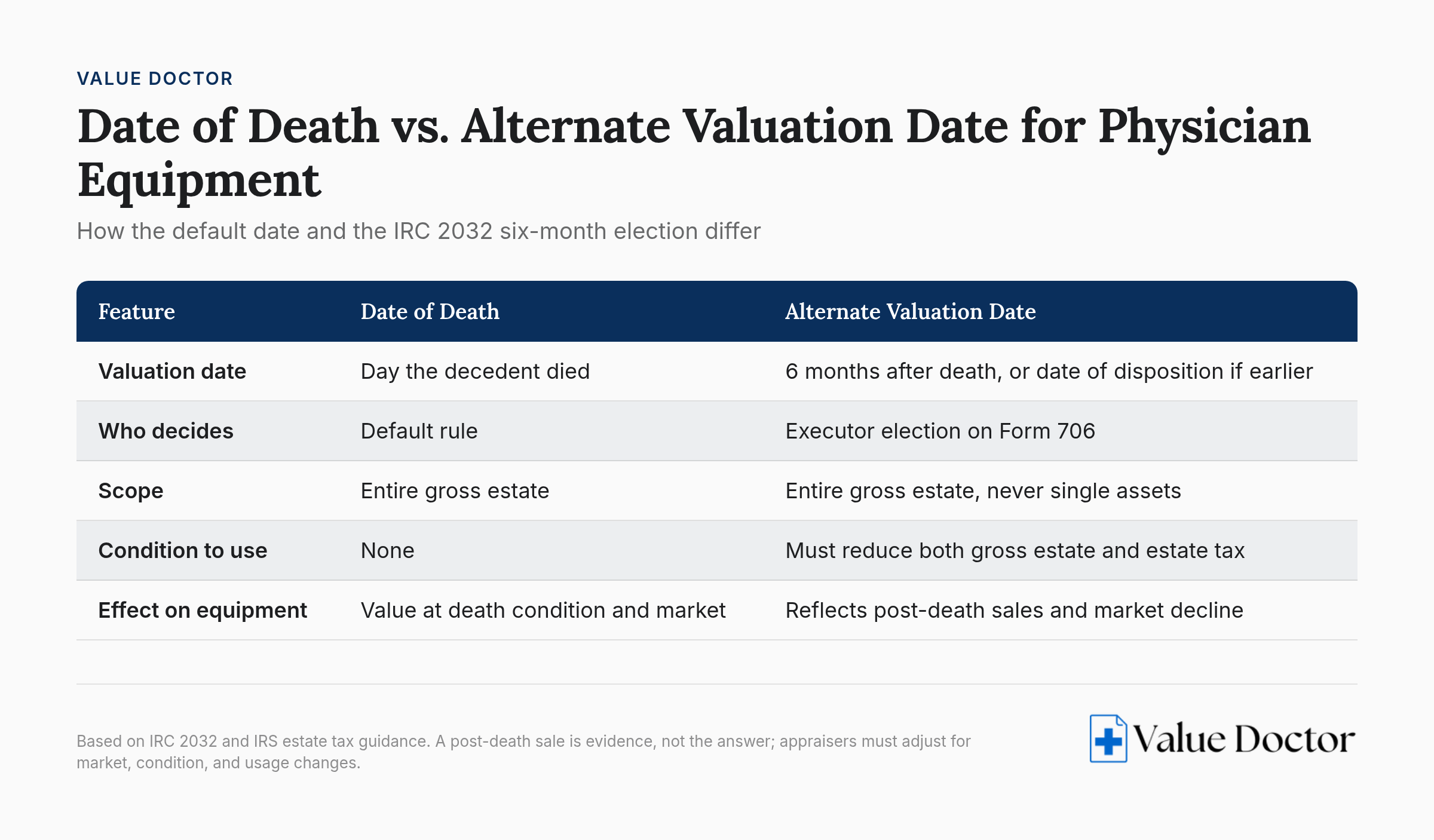
Watch out: A sale after death is evidence, not the answer. The appraiser must account for changes in market conditions, equipment condition, and usage between the 2 dates.
Basis Step-Up for Inherited Medical Equipment
IRC 1014 and Treasury Regulation 1.1014-1 set the income-tax basis of inherited property at its fair market value on the date of death, or on the alternate valuation date when that election is made. Equipment fully depreciated on the practice ledger can receive a new basis equal to its appraised value.
The appraisal therefore carries a second job beyond the estate tax return. A beneficiary who keeps the equipment depreciates from the stepped-up basis, and a beneficiary who sells it measures gain against that same figure. The IRS Form 8971 instructions require the reported value to be fair market value on the applicable valuation date, so the appraised number must stay consistent across filings.
Retrospective Valuation Methods for Medical Equipment
A retrospective appraisal values equipment as it stood on a past date, using evidence available then. IRS Publication 561 lists the factors that guide this work: cost or selling price, sales of comparable property, replacement cost less depreciation, and opinions of professional appraisers. The same publication states that liquidation prices usually do not indicate fair market value.
Our appraisers apply 3 recognized approaches, selected by the asset and the available data:
- Sales comparison: Completed sales of the same or similar models near the valuation date, adjusted for age, configuration, condition, and location.
- Cost approach: The price of a comparable replacement unit, reduced for physical wear, functional obsolescence, and external obsolescence.
- Income approach: Used only when the equipment generates separable, transferable earnings, and never as a restatement of practice profit.
Asking prices are not sale prices, so completed transactions carry more weight than listings.
Condition Evidence on the Valuation Date
Condition evidence separates a working unit from a stranded one. The records our appraisers request include:
- Service logs and maintenance contracts showing the unit's care history
- Calibration and inspection records, including radiation-safety inspections for imaging systems
- Operating hours, scan counts, or procedure counts
- Software versions and licenses that transfer with the unit
- Photographs taken at or near the date of death
- FDA clearance or regulatory status
- Manufacturer end-of-support notices
A unit that the manufacturer stopped supporting before the date of death sells at a discount, because buyers price in the cost of unsupported repair.
Post-Death Sales as Evidence
Revenue Procedure 65-19 presumes that a bona fide sale of tangible personal property at auction or through classified advertising reflects retail value on the valuation date. The presumption holds when the sale occurs within a reasonable period after death and no substantial change occurs in market conditions or circumstances. An executor who sells a digital X-ray unit 3 months after death creates strong evidence, provided the sale was arm's length and publicly marketed.
Separating Equipment Value From Practice Goodwill
Equipment value and practice goodwill are separate assets, and a date-of-death report must not count the same dollars twice. A practice valuation that already includes tangible assets in an enterprise value leaves no room for a second, full equipment figure.
Value Doctor values the equipment as stand-alone tangible property and reports it so a business valuator or CPA can reconcile the 2 numbers. Goodwill, referral relationships, patient lists, and licenses stay outside the equipment appraisal. Our appraisers hold credentials with leading organizations such as the ASA, ISA, and CAGA, and every report is prepared in accordance with USPAP, with the assumptions about what is and is not included stated in the text.
Leased, Financed, and Encumbered Equipment
Ownership comes first. A leased MRI, a lender-owned analyzer, or equipment held under a purchase-money security agreement requires a review of title before the unit enters the estate inventory.
The treatment follows a clear pattern:
- Leased equipment: The lessor owns the unit, so the estate holds at most a purchase option or lease interest.
- Financed equipment: The estate owns the unit at full fair market value, and the lender payoff is reported separately as a debt when the decedent was personally liable.
- Liens: A lien does not reduce the appraised value of the equipment. The CPA or attorney decides how the debt is deducted.
Payoff statements dated at or near the date of death keep these classifications clean.
Documents Executors and CPAs Gather for a Date-of-Death Appraisal
A complete file shortens the appraisal and strengthens the result. The following table lists what executors and CPAs should collect and what each document proves:
| Document | What It Establishes |
|---|---|
| Equipment list with make, model, serial number, and year | Exact identity of each item |
| Purchase invoices | Original cost, configuration, and included options |
| Depreciation schedule, Form 4562, and fixed asset ledger | Acquisition dates, adjusted basis, and items already disposed of |
| Service records and maintenance contracts | Condition, support status, and repair history |
| Calibration and inspection records | Operational and regulatory readiness |
| Lease agreements and lender payoff statements | Ownership, liens, and debt at the date of death |
| Photographs of each item and its location | Condition and installation status |
| Death certificate and letters testamentary | Date of death and the executor's authority |
Pro tip: Photograph equipment before anyone moves, sells, or powers it down. Images from the first week after death are the best condition evidence available.
Example: Valuing a Physician's Equipment at Date of Death
The following scenario is a hypothetical illustration, not a fee quote. A solo physician dies on March 3, leaving an exam-room suite, an ultrasound system, a digital X-ray unit, an autoclave, and an ECG machine. The practice ledger shows the equipment fully depreciated, and an in-office chemistry analyzer is leased.
| Item | Original Cost | Date-of-Death FMV |
|---|---|---|
| Ultrasound system (2019) | $68,000 | $21,000 |
| Digital X-ray unit (2017) | $95,000 | $24,000 |
| Autoclave | $9,500 | $2,400 |
| 6 exam tables | $14,400 | $3,000 |
| ECG machine | $6,200 | $1,800 |
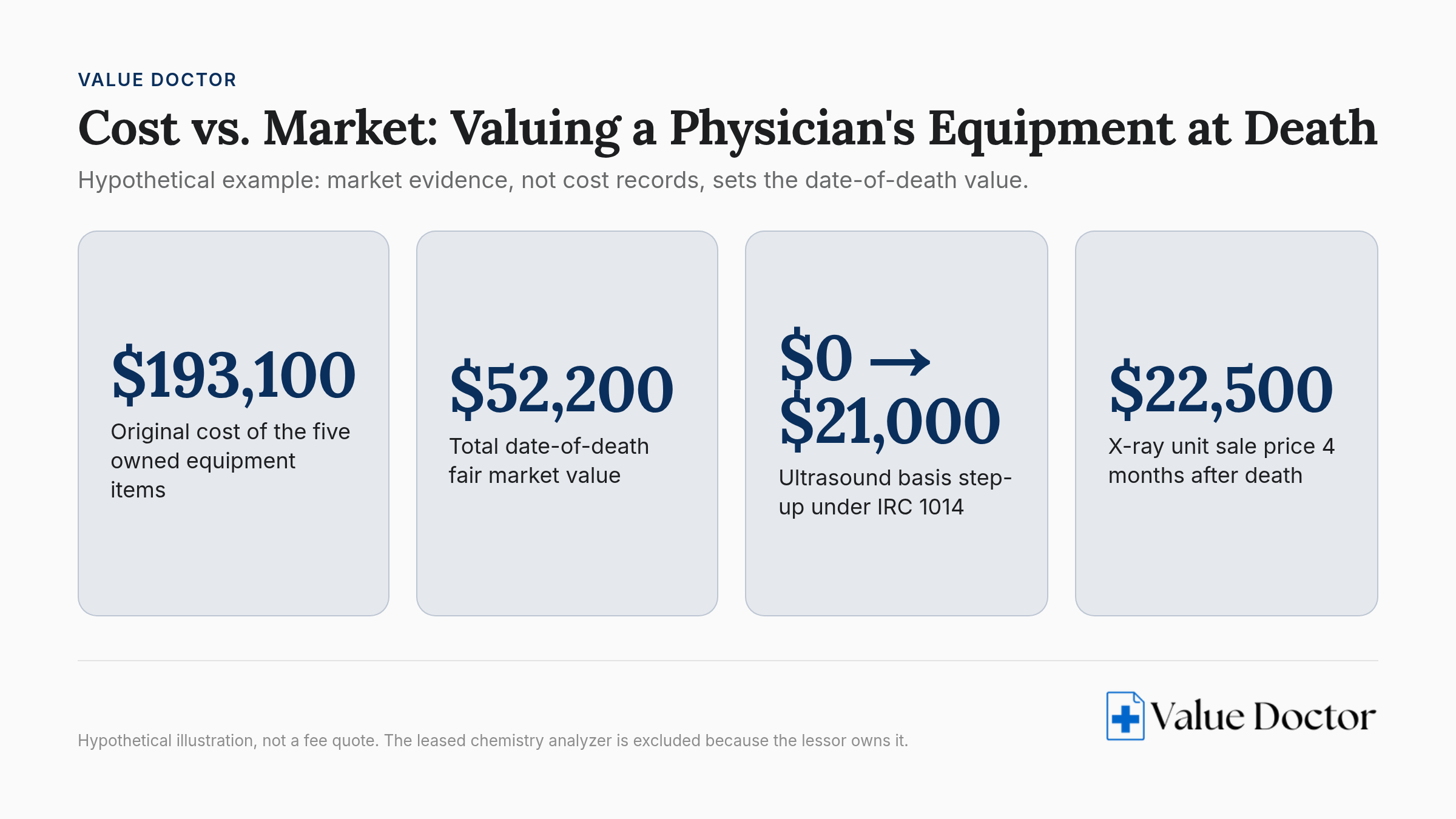
| Total | $193,100 | $52,200 |
The leased analyzer is excluded because the lessor owns it. The ultrasound system carries a ledger basis of $0, so the step-up under IRC 1014 resets its basis to $21,000. If the executor sells the X-ray unit for $22,500 in a bona fide public sale 4 months after death, that price is strong evidence. It also becomes the value of that unit if the executor elects the alternate valuation date.
The lesson is the gap between $193,100 in original cost and $52,200 in fair market value. Cost records inform the appraisal, but market evidence sets the number.
Fixed-Fee Medical Equipment Appraisal at Date of Death
Value Doctor quotes each date-of-death engagement as a fixed fee before work begins, never billed hourly. The fee reflects scope: the number and complexity of items, the completeness of the records, the intended use, and the depth of analysis. Our pricing page explains how scope sets the quote.
Send the equipment list and the documents above, and our appraisers prepare a USPAP-compliant report built for the estate tax return, the probate inventory, and the beneficiaries' basis records.
This article is provided for general informational purposes only and does not constitute legal, tax, or financial advice. Readers should consult a qualified attorney or CPA regarding their specific circumstances.