
Blog
How Technology Obsolescence Erodes Dental and Optometry Equipment Value Over Time
Dental equipment obsolescence value often falls years before a machine physically wears out, driven by software cutoffs and imaging generation turnover rather than age alone. This guide explains why fair market value, not book value or replacement cost, is the number that matters for financing, sales, and insurance.
A digital panoramic X-ray unit can run flawlessly for a decade and still be worth a fraction of its replacement cost, simply because the manufacturer stopped supporting its software three years ago. That gap between "still works" and "still worth something" is the core problem behind dental equipment obsolescence value, and it catches practice owners off guard during financing, sales, and insurance claims. This post walks through why digital imaging platforms, software dependencies, and manufacturer support cycles erode value faster than physical wear, and what that means for getting an accurate number.
Our team prepares dental equipment appraisal and optometry equipment appraisal reports for practice owners navigating exactly this problem, and the pattern shows up in nearly every engagement: the equipment looks fine, but the market has moved on.
What Technology Obsolescence Means for Dental and Optometry Equipment
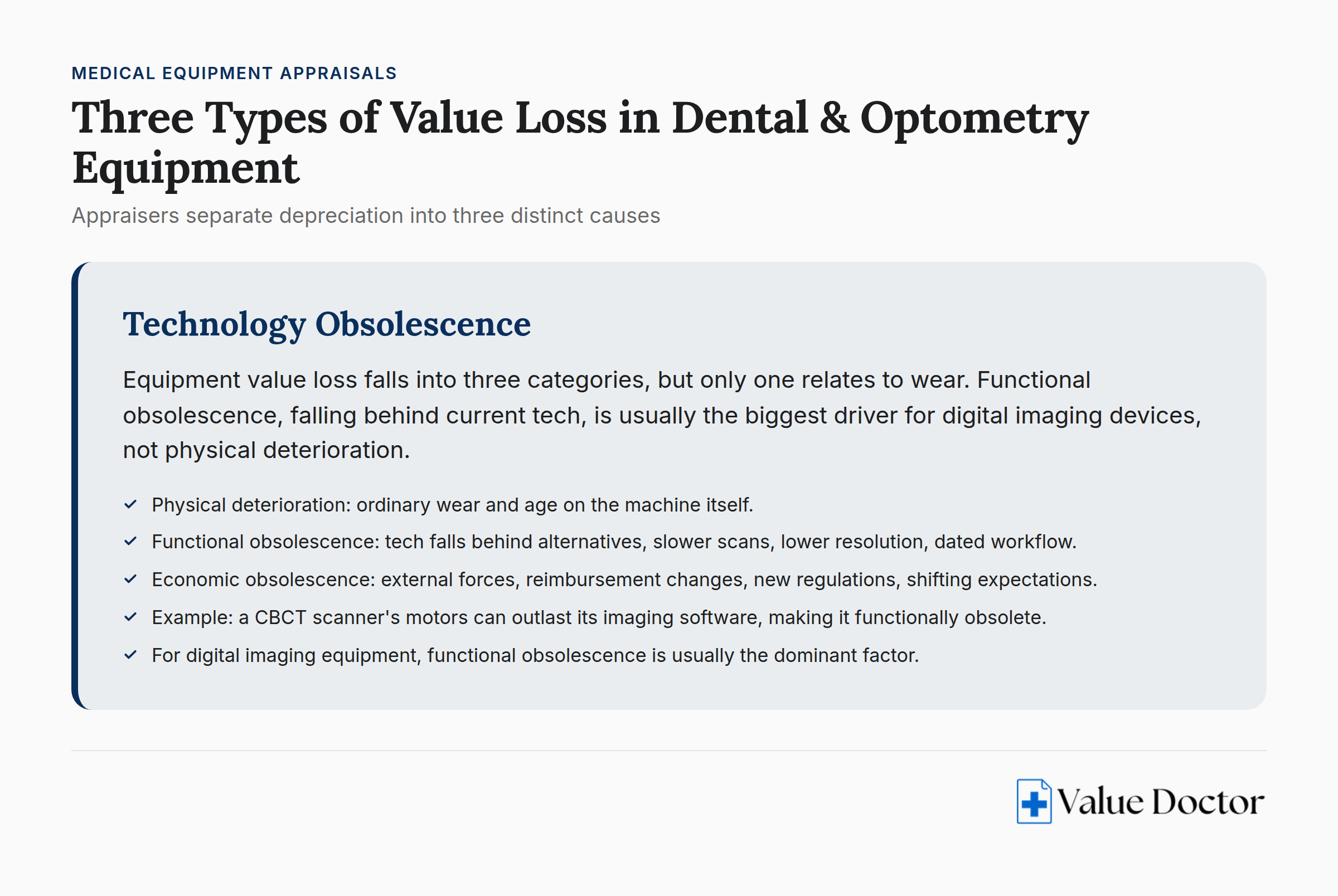
Appraisers separate the loss in an asset's value into three distinct categories, and only one of them has anything to do with how the equipment looks or runs. Physical deterioration is ordinary wear and age. Functional obsolescence is an internal problem: the asset is technologically behind current alternatives, whether that means slower scan times, lower resolution, higher operating costs, or workflow that no longer fits how a modern practice runs. Economic obsolescence comes from outside the asset entirely: reimbursement changes, new regulations, or a shift in what the market expects from a piece of equipment.
For a piece of dental or optometry equipment, physical deterioration is usually the smallest factor. A CBCT scanner's motors and gantry can easily outlast the software platform that makes its images usable in a modern treatment workflow. That's functional obsolescence doing the damage, not wear.
Why Digital Imaging Platforms Age Faster Than the Metal Around Them
Digital imaging and CAD/CAM systems depreciate faster in the market than their physical condition would suggest because their value is tied to a software and sensor ecosystem, not just hardware durability. Intraoral scanners, digital sensors, and CAD/CAM milling units depend on compatible, regularly updated software to stay clinically competitive, and once that ecosystem moves on, the hardware's market value moves with it even if the unit still functions perfectly.
This is the mechanical-life-versus-economic-life gap in practice. A dental chair or delivery unit, built around mechanical and hydraulic components, can have a useful engineering life well past 10 years. A digital sensor or intraoral scanner, by contrast, is judged against whatever sensor resolution and integration standard is current at the moment of sale, and that standard moves every few years regardless of how well the original unit was maintained.
Watch out: Book value and fair market value are not the same thing, and confusing them is the single most common mistake we see. An asset can be fully depreciated on the books, sitting at or near $0, while still carrying real resale demand because its technology generation remains relevant. The reverse happens just as often: an asset with years of book value left has already lost most of its market value because its software support ended.
Manufacturer Support Cycles: The Hidden Value Cliff
The single biggest driver of obsolescence in digital dental and optometry equipment is the manufacturer support cycle, not the calendar. As long as a manufacturer keeps issuing software updates, security patches, and compatibility bridges to newer practice management or EMR systems, a digital device holds its place in the market. Once that support ends, the device's value doesn't decline gradually. It tends to plateau, then drop sharply.
CBCT scanners are a clear example of this pattern. Many hold value reasonably well through the first several years of service, then experience a pronounced value drop once the manufacturer discontinues software support for that generation of unit, even though the imaging hardware itself hasn't changed. The same dynamic shows up in optometry with OCT systems, autorefractors, and visual field analyzers: appraisers evaluating these devices under Uniform Standards of Professional Appraisal Practice (USPAP) weigh age and condition alongside technology generation and the current resale market for that specific equipment class, because those two factors often matter more than years in service.
Mechanical and optical devices without a software dependency behave very differently. A phoropter or a set of trial lenses isn't tied to a firmware update schedule, so its value tends to erode slowly and predictably along with ordinary physical wear, the way appraisers expect a durable mechanical asset to behave.
Tax Depreciation vs Fair Market Value: Two Different Clocks
Tax depreciation schedules and appraised fair market value are not measuring the same thing, and treating them as interchangeable is where a lot of practice owners get into trouble. Under the IRS's Modified Accelerated Cost Recovery System guidance in Publication 946, most dental and medical equipment is classified as 5-year or 7-year property for depreciation purposes, meaning it can be written down to near-zero book value well before the end of its useful clinical life.
That classification is a tax policy decision, not an engineering or market assessment. Industry guidance on dental equipment depreciation confirms that many practices see their core clinical equipment, including chairs, imaging systems, and delivery units, treated as 5-year property specifically because of how quickly that category tends to face technological turnover, and cost segregation studies for dental offices use the same shorter recovery period for specialized clinical assets rather than the longer schedules used for general office furniture.
An appraiser's job in a fair market value engagement is different from an accountant's job on a depreciation schedule. The appraiser starts from what a willing buyer would actually pay for that specific asset today, given its condition, its technology generation, and the resale market for that equipment class, not from a fixed statutory recovery period.
Category Patterns: Which Equipment Loses Value Fastest
Not every category of dental and optometry equipment loses value at the same rate, and knowing the pattern for a given asset class helps set realistic expectations before an appraisal even begins. Industry depreciation guidance for dental practices lays out typical service-life expectations by equipment type, and appraisers see the market value curve track fairly closely with those patterns.
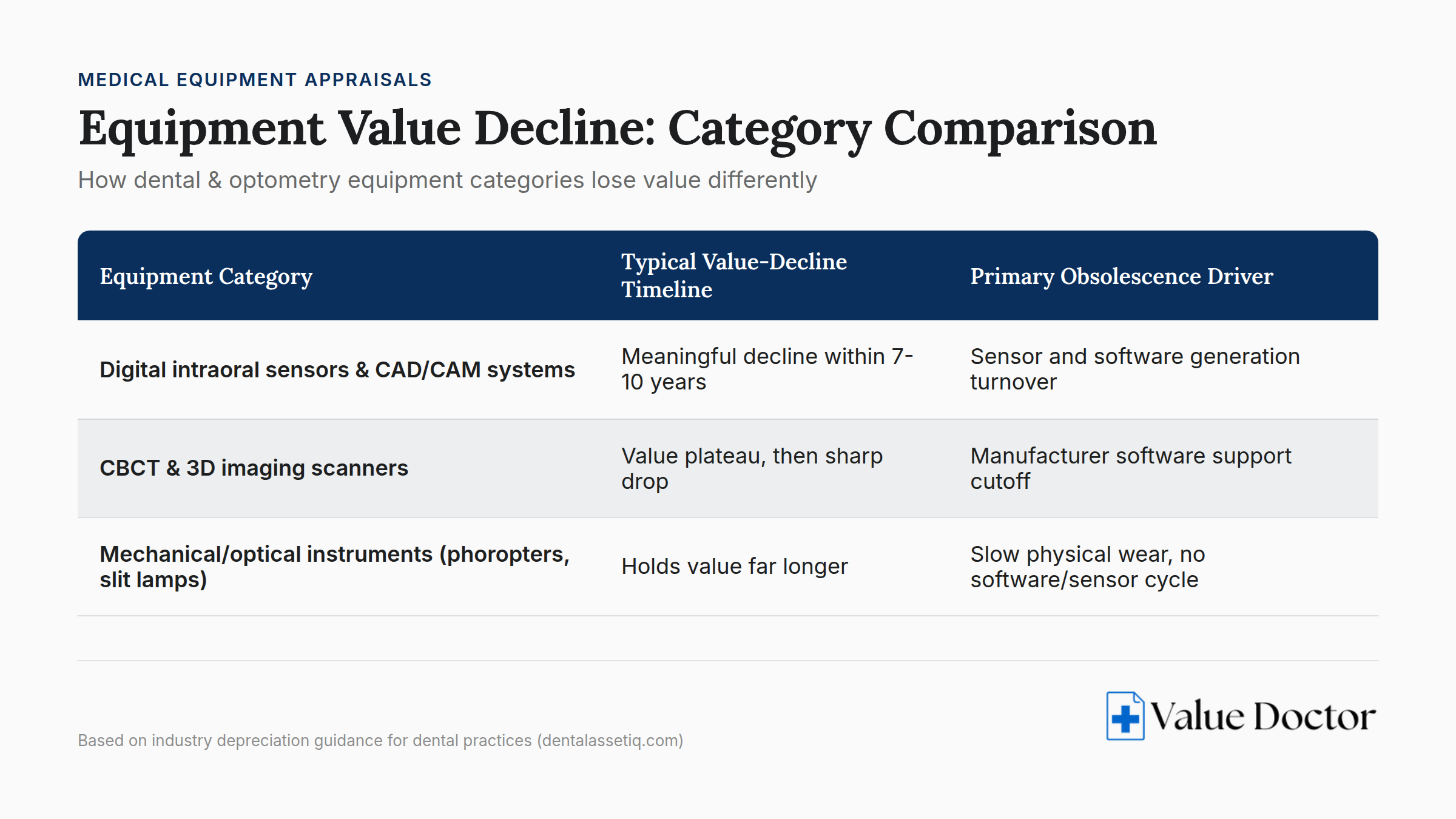
- Digital intraoral sensors and CAD/CAM systems typically see meaningful value decline within 7 to 10 years of service, driven by sensor and software generation turnover rather than mechanical failure.
- CBCT and 3D imaging scanners often hold a value plateau for several years, then drop sharply once the manufacturer ends software support for that specific model or platform.
- Mechanical and optical instruments, such as phoropters, slit lamps, and non-digital exam equipment, hold value far longer because they aren't tied to a software or sensor refresh cycle at all.
Pro tip: When budgeting for a practice sale, buy-in, or refinancing, don't assume every piece of equipment on the asset list depreciates at the same pace. A five-year-old CBCT unit and a five-year-old phoropter are very likely sitting at completely different points on their respective value curves.
Why the Obsolescence-Adjusted Number Matters
Getting this number wrong has consequences that show up well beyond an accountant's ledger. Lenders using dental or optometry equipment as loan collateral need a realistic fair market value, not a replacement cost or a leftover book value, to size a loan appropriately. Practice sale and acquisition negotiations frequently stall when a seller values the imaging suite at replacement cost while a buyer correctly prices in the obsolescence risk on aging digital platforms.
Insurance claims raise the same issue in reverse. A practice filing a claim after equipment loss needs documentation that reflects what the equipment was actually worth in the current market, not an inflated replacement figure that invites pushback from the insurer, or a depreciated book value that leaves the practice underpaid. Partner buy-in and buyout valuations for dental and optometry practices depend on the same accuracy: overstating aging imaging equipment inflates a departing partner's payout, while understating it shortchanges the practice's true asset base.
An appraisal prepared in accordance with USPAP gives every party in these situations a defensible, standards-compliant basis for the number, whether the audience is a lender, a buyer's accountant, an insurer, or a court in a practice merger or acquisition dispute. None of these uses guarantee that any specific reviewer will accept a particular figure; what a compliant appraisal provides is a methodology and documentation trail that holds up to scrutiny.
How Appraisers Isolate Functional Obsolescence
Isolating how much of an asset's value loss comes from technology obsolescence, rather than age or physical wear, requires a structured comparison rather than a guess. Appraisers typically look at three things side by side for the specific unit being valued:
- Excess operating cost. Does the asset cost more to run, maintain, or staff than a current equivalent doing the same clinical job?
- Capacity and output versus modern alternatives. Can the asset produce the same image quality, scan speed, or throughput as equipment currently on the market, or does it fall short in ways that affect clinical use?
- Market comparison to modern substitutes. What are buyers actually paying for comparable used equipment of the same technology generation, versus equipment one or two generations newer?
This is where a formal appraisal earns its keep over an internal estimate. Fixed-fee engagements are scoped around the number of assets, the complexity of the technology categories involved, and whether the report needs to meet IRS-qualified or standard reporting requirements, never billed hourly and never priced off the asset's market value itself.
Getting an Obsolescence-Adjusted Value You Can Rely On
The practical takeaway is straightforward: age alone doesn't tell you what dental or optometry equipment is worth. A five-year-old digital sensor and a five-year-old mechanical exam chair can sit on opposite ends of the value curve, and only an appraisal that accounts for software support cycles, technology generation, and the current resale market will catch that difference. Whether the appraisal is feeding into a loan application, a practice sale, an insurance claim, or a partner buyout, starting from replacement cost or leftover book value instead of true fair market value is a common and costly mistake.
Our team prepares USPAP-compliant appraisals for dental and optometry practices that need a defensible, obsolescence-adjusted valuation rather than a generic depreciation schedule. Request an appraisal to get your equipment scoped and quoted as a fixed fee before any work begins.
This article is provided for general informational purposes only and does not constitute legal, tax, or financial advice. Readers should consult a qualified attorney or CPA regarding their specific circumstances.