
Blog
Fair Market Value vs Liquidation Value for Medical Equipment: What Changes the Number
The same ultrasound system can carry three legitimate but different dollar figures depending on why it's being appraised. This guide breaks down fair market value, orderly liquidation value, and replacement cost new for medical equipment so you know which number applies to your situation.
A hospital selling a 3-year-old ultrasound system to settle an estate, a bank seizing the same machine as loan collateral, and an insurer replacing it after a flood will each receive a different appraised value for that identical piece of equipment. None of those numbers is wrong. Each answers a different question, because each is built on a different standard of value. Understanding which standard applies to your situation, and why the figures diverge, keeps you from misusing a report or challenging a number that was never meant to match your expectation in the first place.
Why One Machine Can Have Three Different Appraised Values
An appraisal is only as good as the definition of value behind it. Before an appraiser ever inspects a piece of equipment, they have to answer a prior question: what standard of value does this assignment call for? The Appraisal Foundation's Uniform Standards of Professional Appraisal Practice requires every appraiser to identify the applicable standard of value and the intended use of the report before drawing a conclusion. Skip that step, and the resulting number is unreliable no matter how careful the inspection was.
That single requirement explains why a used MRI scanner can carry three defensible but different dollar figures. The equipment does not change. The purpose of the appraisal does, and the purpose dictates the standard.
Our medical equipment appraisal team is asked, almost weekly, why a number from one report does not match a number from another report on the same machine. The answer is almost always this: the two reports were prepared under different standards of value for different intended uses.
What Is Fair Market Value for Medical Equipment?
Fair market value is the price a piece of equipment would fetch in a transaction between a willing buyer and a willing seller, neither one under any compulsion to act, both reasonably informed about the asset. The IRS defines it this way in Publication 544, and it is the standard behind most estate, gift, and charitable donation appraisals.
Fair market value assumes an orderly, unhurried sale process with no time pressure on either party. It is the standard the IRS expects to see on Form 8283 charitable donation appraisals and in estate tax filings, and it generally represents the highest of the three values discussed in this article because it assumes normal market conditions rather than distress.
Fair market value is also the standard used for arm's length practice sales, where one healthcare business buys equipment from another as part of an ordinary transaction. IRS Publication 561 frames replacement cost as a component appraisers may weigh when estimating value for donated property, but the ultimate conclusion for a donation appraisal still has to land on fair market value, not on what it would cost to buy the item new.
Watch out: A donor who assumes their donated equipment is worth what they originally paid for it, minus a little wear, is almost always overestimating. Fair market value reflects what an informed buyer would actually pay today, not the original purchase price adjusted for age.
What Is Orderly Liquidation Value?
Orderly liquidation value is the amount a piece of equipment would likely bring if it had to be sold within a limited but reasonable time frame, typically because the seller is under some form of compulsion. It is generally lower than fair market value, and the gap exists because of the compulsion built into the definition itself, not because the equipment is somehow worth less.
Lenders and asset-based lenders rely on orderly liquidation value when they need to know what collateral is worth if a borrower defaults and the equipment has to be moved quickly. Bankruptcy trustees, workout specialists, and secured creditors use the same standard when a distressed business needs to convert equipment into cash within weeks or months rather than through a normal sales cycle. General equipment financing guidance also treats liquidation value as the figure lenders lean on when assessing recovery risk on secured assets, since it accounts for the practical friction of a forced timeline rather than a leisurely one (as described in general lending industry guidance on used equipment valuation).
For medical equipment specifically, orderly liquidation value also has to account for de-installation, transportation, recalibration, and testing costs that a buyer in a normal fair market transaction might not face in the same way. An MRI or CT scanner that has to be pulled out of a hospital wing, shipped, and re-certified elsewhere carries real friction costs that a liquidation sale absorbs and a fair market transaction often does not.
Example: A hospital financing new radiology equipment through a secured loan may see its existing imaging fleet appraised at orderly liquidation value as part of the collateral package, a figure the lender uses to size the loan, not a figure the hospital would use to price a private sale.
What Is Replacement Cost New?
Replacement cost new is the amount it would take to acquire a brand new piece of equipment of like kind and capability today. It is explicitly not the same thing as fair market value, and confusing the two is one of the more common mistakes in equipment insurance discussions.
Insurance policies covering medical equipment are frequently written on a replacement cost basis, meaning a covered loss is settled based on what it costs to replace the damaged or destroyed equipment with new equipment of similar type and function, not on what the used equipment could have been sold for the day before the loss. That distinction matters enormously for high-value diagnostic imaging equipment, where new list prices can run well above what the used market would ever pay for a comparable machine.
Our medical equipment appraisal for insurance work regularly involves replacement cost new figures precisely because insurers need a defensible number that reflects what it costs to make a facility whole again, not what a depreciated asset was worth on the secondary market. A carrier that settled claims at fair market value rather than replacement cost would routinely underpay facilities relative to their actual coverage need, which is exactly why the two standards are kept distinct in policy language.
Comparing the Three Standards of Value
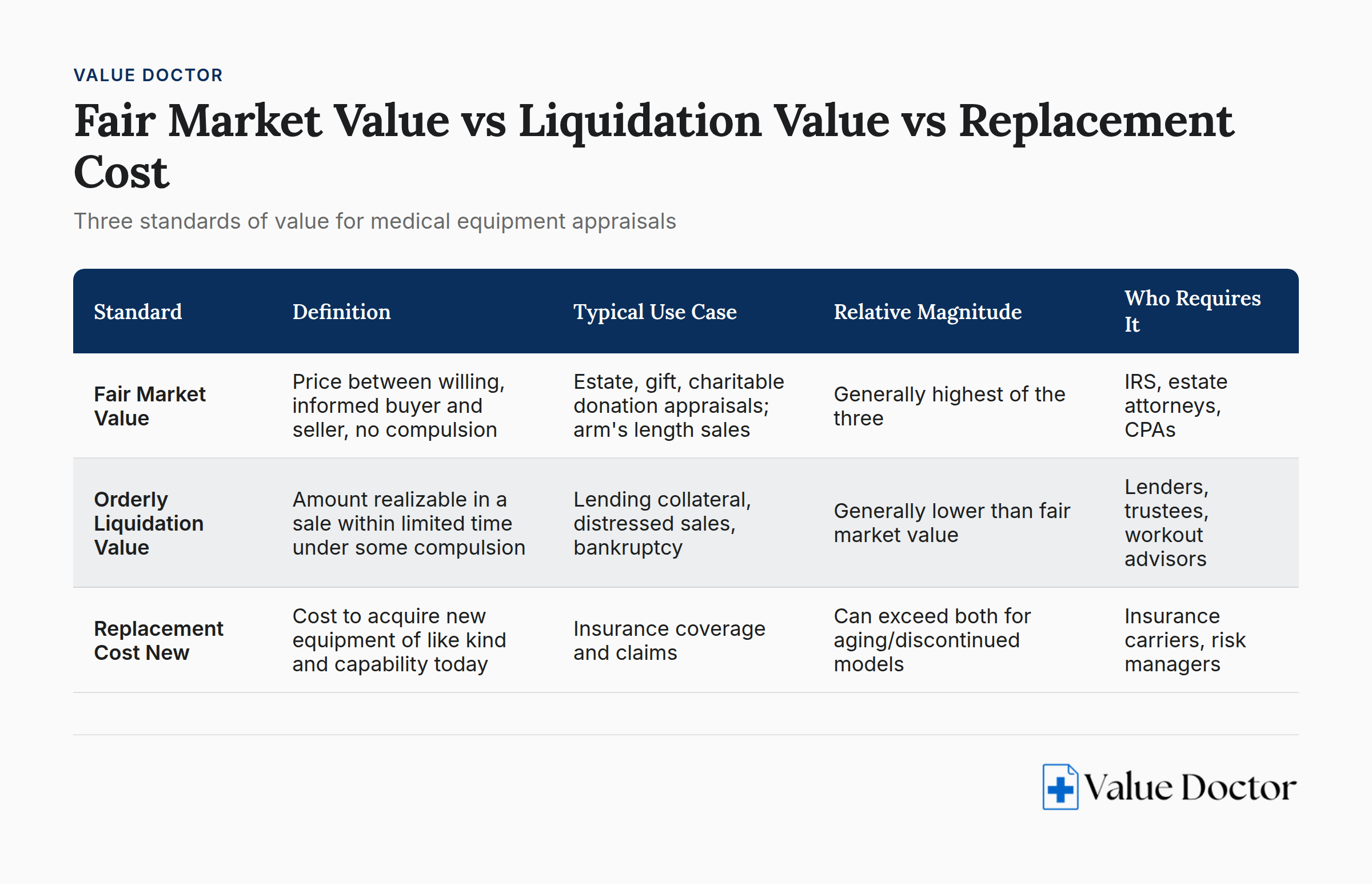
The table below lays out how the three standards differ in definition, typical use case, relative magnitude, and who typically requires each one.
| Standard of Value | Definition | Typical Use Case | Relative Magnitude | Who Requires It |
|---|---|---|---|---|
| Fair Market Value | Price between a willing, informed buyer and seller, neither under compulsion | Estate, gift, and charitable donation appraisals; arm's length practice sales | Generally the highest of the three | IRS, estate attorneys, CPAs |
| Orderly Liquidation Value | Amount realizable in a sale within a limited but reasonable time frame under some compulsion | Lending collateral, distressed sales, bankruptcy | Generally lower than fair market value | Lenders, trustees, workout advisors |
| Replacement Cost New | Cost to acquire new equipment of like kind and capability today | Insurance coverage and claims | Can exceed both of the above for aging or discontinued models | Insurance carriers, risk managers |
Worked Example: A 3-Year-Old Ultrasound System
Consider a 3-year-old cart-based ultrasound system that sold new for a price in the low six figures. The same machine, appraised on the same date, could reasonably generate three different figures depending on which standard of value applies.
Under fair market value, an appraiser would look at completed sales of comparable used systems on the open secondary market, factoring in the unit's age, condition, software version, and probe inventory. That figure typically lands somewhere in the range of 40% to 60% of the original purchase price for a well-maintained 3-year-old system, reflecting normal market depreciation and reasonable demand from other clinics or imaging centers.
Under orderly liquidation value, that same system, being sold because a clinic is closing within a compressed 60- to 90-day window, would likely come in below the fair market figure. Liquidation buyers price in the risk that a compressed timeline limits the pool of interested purchasers, and they typically factor in de-installation and transport costs the seller may have to absorb. A discount in the range of 15% to 30% off fair market value is a common industry pattern for equipment sold under this kind of compulsion, though the exact discount depends heavily on how specialized the equipment is and how thin the secondary market runs.
Under replacement cost new, the figure jumps in the opposite direction. Buying a brand new ultrasound system with comparable or improved specifications, at current list pricing, would almost certainly cost more than either the fair market or liquidation figure, sometimes substantially more if the original model has since been upgraded or discontinued and only a newer, pricier successor is available.
Key takeaway: None of these three numbers is inflated or deflated. They are answering three different questions about the same asset, and a report that blends them together, or applies the wrong one to your situation, will not hold up to scrutiny from an IRS examiner, a loan underwriter, or a claims adjuster.
Why Matching the Standard of Value to the Intended Use Matters So Much
An appraisal is written for a specific purpose, and that purpose determines which standard of value governs the assignment. USPAP requires appraisers to state the standard of value and the intended use explicitly in every report, and that requirement exists precisely because the same piece of equipment supports multiple legitimate values depending on why it is being valued.
Pro tip: If you are requesting an appraisal, tell the appraiser exactly what the report is for (an estate filing, a loan application, an insurance claim, a donation deduction) before the engagement begins. That single piece of information determines which standard of value governs the whole assignment, and getting it wrong at the outset means redoing the work.
A report built on the wrong standard of value is not just imprecise, it is unusable for its intended purpose. An estate attorney who submits a replacement cost figure to the IRS in place of fair market value risks having the entire deduction challenged. A lender who accepts a fair market value figure as loan collateral risks overstating recovery value if the borrower defaults. Choosing the correct standard is not a technicality; it is the foundation the rest of the report rests on.
Getting the Right Number for Your Situation
The number on a medical equipment appraisal only means something once you know which question it was built to answer. Fair market value tells you what an informed buyer would pay in a normal transaction. Orderly liquidation value tells you what a lender or trustee could realistically recover under time pressure. Replacement cost new tells you what it takes to make a facility whole after a loss. Confusing any of these standards, or asking an appraiser to skip defining one, undermines the reliability of the entire report regardless of how thorough the physical inspection was.
Our credentialed appraisers hold credentials with organizations such as the ASA and ISA, and every engagement starts by pinning down the intended use and the applicable standard of value before any inspection begins. If you need a medical equipment valuation for an estate, a loan, an insurance claim, or a sale, request an appraisal and we will scope the assignment to the standard your situation actually requires.
This article is provided for general informational purposes only and does not constitute legal, tax, or financial advice. Readers should consult a qualified attorney or CPA regarding their specific circumstances.