
Blog
How to Complete IRS Form 8283 for a Medical Equipment Donation, Section by Section
Donating an ultrasound machine, exam table, or hospital bed above $500 triggers IRS Form 8283, and crossing $5,000 adds a qualified appraisal requirement. This walkthrough covers exactly which sections apply, who signs what, and how the timing and grouping rules work for medical equipment.
Hospitals, clinics, and physician practices donate retired imaging machines, exam tables, surgical instruments, and hospital beds more often than most tax preparers realize. What often gets missed is that the value of that donation determines a specific paperwork path on IRS Form 8283, and getting the wrong section, signature, or timing can put the deduction at risk. This guide walks through Form 8283 as it applies to medical equipment donations, section by section, so donors, appraisers, and receiving organizations know exactly what's expected of each of them.
When Does a Medical Equipment Donation Trigger Form 8283?
Form 8283 becomes relevant the moment your total noncash charitable deductions for the year exceed $500. Below that, no form is needed at all. Above it, the specific requirements scale with the value of the equipment involved.
The IRS instructions for Form 8283 and IRS Topic No. 506 set out three thresholds that matter for medical equipment donors:
- Over $500 but $5,000 or less per item or group of similar items: complete Section A of Form 8283. No qualified appraisal is required, though the claimed value still has to reflect fair market value.
- Over $5,000 per item or group of similar items: complete Section B, which requires a qualified appraisal and signatures from the appraiser and the donee organization.
- Over $500,000 for a single contribution: complete Section B and physically attach the qualified appraisal report to the tax return, not just a summary of it.
A donated infusion pump valued at $3,000 stays in Section A. A donated MRI scanner valued at $40,000 requires Section B, a qualified appraisal, and donee sign-off. Our team handles the appraisal side of this through our medical equipment appraisal services for charitable donation, scoped to whichever threshold your equipment falls into.
Section A vs Section B: What Actually Changes
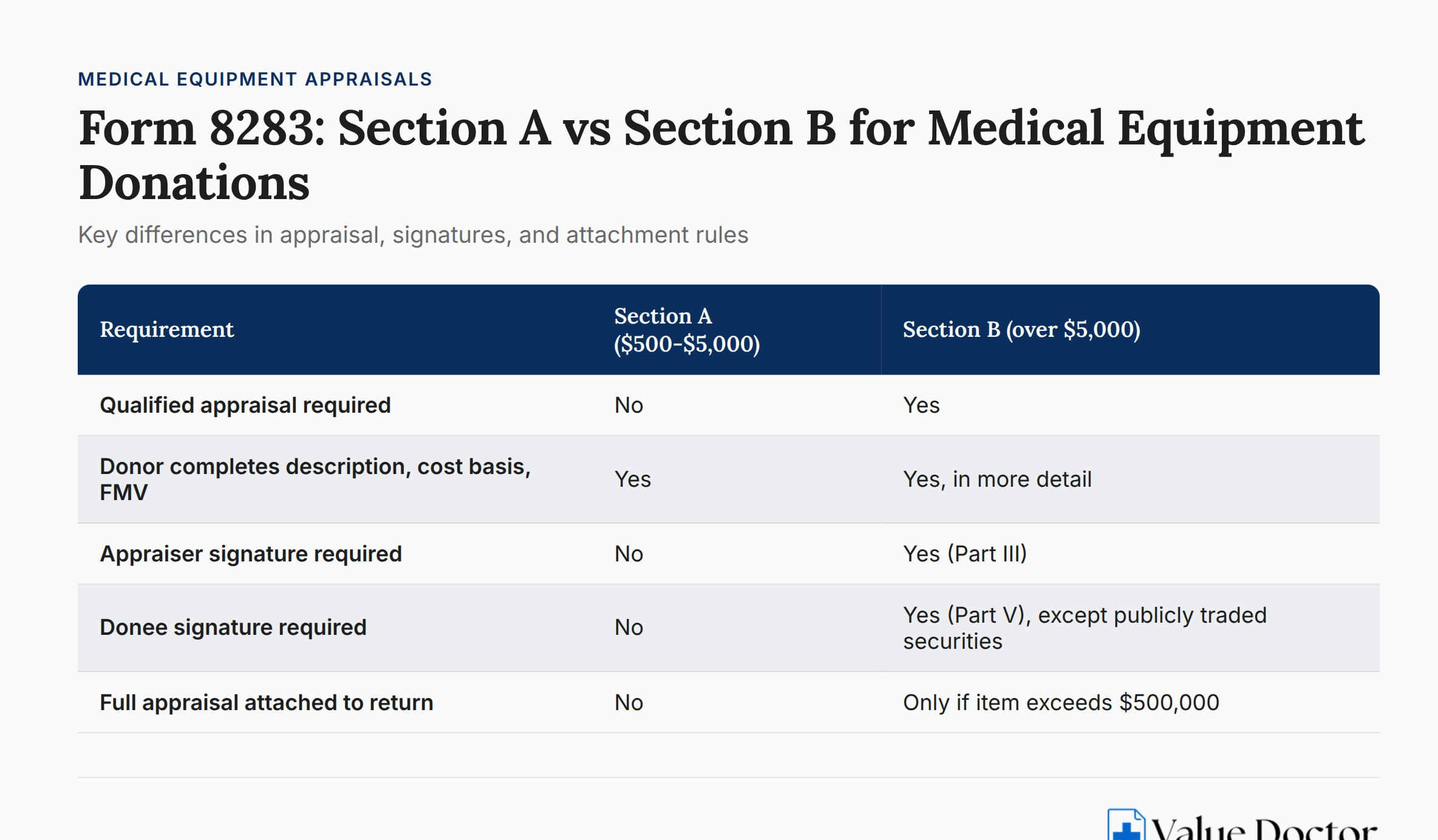
The practical difference between the two sections comes down to three things: whether an appraisal is required, who has to sign, and how much detail the form demands about the equipment itself.
| Requirement | Section A ($500-$5,000) | Section B (over $5,000) |
|---|---|---|
| Qualified appraisal required | No | Yes |
| Donor completes description, cost basis, FMV | Yes | Yes, in more detail |
| Appraiser signature required | No | Yes (Part III) |
| Donee signature required | No | Yes (Part V), except publicly traded securities |
| Full appraisal attached to return | No | Only if the item exceeds $500,000 |
A fixed fee applies regardless of which section a donation lands in; our published pricing for medical equipment appraisals runs from $295 for a standard report to $395 and up for an IRS-qualified appraisal suited to Section B, with the final quote set after we scope the specific equipment and intended use. Fees are driven by the complexity of the equipment, the number of items, and the depth of analysis required, never by the equipment's market value itself.
Who Completes and Signs Each Part of Section B?
Section B splits responsibility across three parties, and confusing who signs what is one of the most common reasons a Form 8283 comes back incomplete.
- Donor completes Part I. This is the description of the donated equipment (make, model, serial number, condition), how and when it was acquired, the donor's cost or adjusted basis, and the date of contribution. For a donated CT scanner, this means enough detail that someone unfamiliar with the machine could identify it.
- Donor completes Part IV. This is the donor's statement covering whether the donee's use relates to its exempt purpose (a hospital using a donated ventilator in patient care clearly qualifies) and any restrictions placed on the equipment's use or resale.
- The qualified appraiser completes Parts II and III. Part II summarizes the appraisal (appraised value, date, valuation method). Part III is the Declaration of Appraiser, where the appraiser certifies they meet the qualification standards under the applicable Treasury regulations and have not been barred from practicing before the IRS. That regulatory definition of a qualified appraiser is spelled out in the Treasury regulations on substantiation of charitable contributions.
- The donee organization completes Part V. The receiving hospital, clinic, or nonprofit acknowledges that it received the described equipment on the stated date. An authorized official signs on the organization's behalf.
Watch out: The donee's signature in Part V is an acknowledgment of receipt, not an endorsement of the appraised value. A hospital that accepts a donated ultrasound machine is confirming it received the equipment described, not vouching for what it's worth.
Timing Rules: When Must the Appraisal Be Dated?
A qualified appraisal for medical equipment has a narrow window. It must be dated no earlier than 60 days before the date the equipment is actually donated, and it must be in the donor's hands no later than the due date, including extensions, of the tax return on which the deduction is first claimed.
That timing rule comes from the regulations governing substantiation of noncash charitable contributions and is echoed in the guidance behind IRS Publication 561 on determining the value of donated property. Example: A clinic donates a diagnostic imaging system on March 1. The appraisal can be dated any time between January 1 and March 1, but it needs to be finished well before the practice files its return in April, or before whatever extended deadline applies.
Pro tip: Book the appraisal before the equipment leaves the building, not after. An appraiser can document condition, serial numbers, and comparable market data far more accurately while the equipment is still on-site and operational.
The Similar-Items Grouping Rule for Medical Equipment
The IRS treats a group of similar items contributed in the same year as a single item for threshold purposes, and this rule matters a lot for medical equipment donors who give away multiple pieces at once.
Example: A physician practice closes an exam room and donates the following to one clinic in the same tax year:
| Item | Category | Claimed value | Treatment |
|---|---|---|---|
| Exam table 1 | Furniture/fixtures | $1,500 | Grouped with similar items |
| Exam table 2 | Furniture/fixtures | $1,500 | Grouped with similar items |
| Exam table 3 | Furniture/fixtures | $1,500 | Grouped with similar items |
| Portable ultrasound machine | Diagnostic equipment | $6,000 | Separate category, evaluated on its own |
The three exam tables are similar items of the same general category, so their values are added together for threshold purposes: $4,500 total, which keeps them in Section A. The ultrasound machine is a dissimilar item in its own category and is evaluated independently. Because it exceeds $5,000 on its own, it requires a separate qualified appraisal and Section B. The instructions for Form 8283 allow one appraisal to cover a group of similar items contributed in the same year, as long as the report includes the required information for each item, but dissimilar items still need to be evaluated, and often appraised, on their own terms.
Our hospital equipment appraisal engagements regularly involve exactly this mix: multiple similar fixtures grouped together alongside one or two higher-value diagnostic units that need to stand on their own appraisal.
What Happens After the Donation: Form 8282 and the Three-Year Rule
The donor's paperwork isn't the only filing obligation tied to a medical equipment donation. If the donee organization sells, trades, or otherwise disposes of the equipment within three years of receiving it, the organization generally must file Form 8282 with the IRS and send a copy to the donor.
This matters for medical equipment specifically because donated devices often get resold into the secondary market, refurbished, or transferred to another facility rather than kept indefinitely. The IRS guidance on charitable organizations substantiating noncash contributions notes an exception for items valued at $500 or less, provided the donor identified those items and signed the relevant statement on Form 8283. For anything above that, the three-year disposition reporting requirement stands.
Getting the Appraisal Right the First Time
Form 8283 rewards precision. The right section, the right signatures, and an appraisal dated inside the correct window are what stand between a clean deduction and a return that draws IRS scrutiny. Our appraisers hold credentials with organizations including the American Society of Appraisers and the International Society of Appraisers, and every donation report we prepare is built to satisfy Section B's qualified appraisal requirements from the start, whether the asset is a single ultrasound machine or an entire exam room's worth of retired equipment.
This article is provided for general informational purposes only and does not constitute legal, tax, or financial advice. Readers should consult a qualified attorney or CPA regarding their specific circumstances.