
Blog
Healthcare Asset Appraisal: What It Covers and When You Need One
A healthcare asset appraisal establishes a defensible value for everything from imaging systems to lab instruments, but the right standard of value changes depending on whether you're facing financial reporting, an acquisition, or a charitable donation. This guide maps what a healthcare equipment appraisal actually covers and the specific situations that call for one.
A healthcare asset appraisal is a documented, independent opinion of value for medical and facility-related property, developed under a specific standard of value, premise, and effective date that matches the reason you need it. It's not a single number that applies everywhere. The same MRI scanner can carry three different defensible values depending on whether it's being valued for an insurance claim, a purchase price allocation, or an IRS-qualified donation.
This matters because healthcare organizations and individuals run into appraisal needs constantly: equipment trades hands in mergers, machines get donated when a practice upgrades, lenders want collateral values, and courts need numbers for estates and divorces. Our team prepares appraisals across the full range of healthcare equipment, and this guide walks through what a healthcare asset appraisal actually examines and the situations where one becomes necessary.
What a Healthcare Asset Appraisal Covers
A healthcare asset appraisal identifies and analyzes the physical condition, functional status, and market position of equipment used in clinical, diagnostic, and administrative care. The scope typically spans five broad categories.
- Facility and biomedical equipment: patient beds, monitors, infusion pumps, sterilization systems, and the general biomedical inventory that keeps a facility running day to day. Our hospital equipment appraisal service covers this category in depth, including multi-department inventories spanning dozens of equipment types.
- Imaging systems: MRI, CT, ultrasound, and X-ray units, where configuration, software version, and coil or detector condition drive value far more than age alone.
- Surgical and diagnostic equipment: operating room tables, endoscopy towers, anesthesia machines, and diagnostic scopes, which require close attention to service contracts and usage hours.
- Laboratory instruments: analyzers, centrifuges, and specialized testing equipment, where calibration history and reagent compatibility affect both function and resale value. Our lab equipment appraisal team handles these assignments specifically.
- Healthcare IT and biomedical systems: integrated diagnostic software, PACS systems, and the biomedical device networks that increasingly tie equipment value to licensing and interoperability rather than hardware alone.
Dental chairs, optometry lanes, and general medical machinery fall under this same umbrella and are appraised using the same core methodology, adjusted for the equipment's specific market.
For every category, the appraiser identifies manufacturer, model, serial number, configuration, and installed options, then evaluates physical condition, maintenance history, and remaining useful life. Functional obsolescence (whether the equipment remains clinically competitive against newer technology) and economic obsolescence (external pressures like reimbursement changes or a thin secondary market) both factor into the final conclusion.
The Three Valuation Approaches
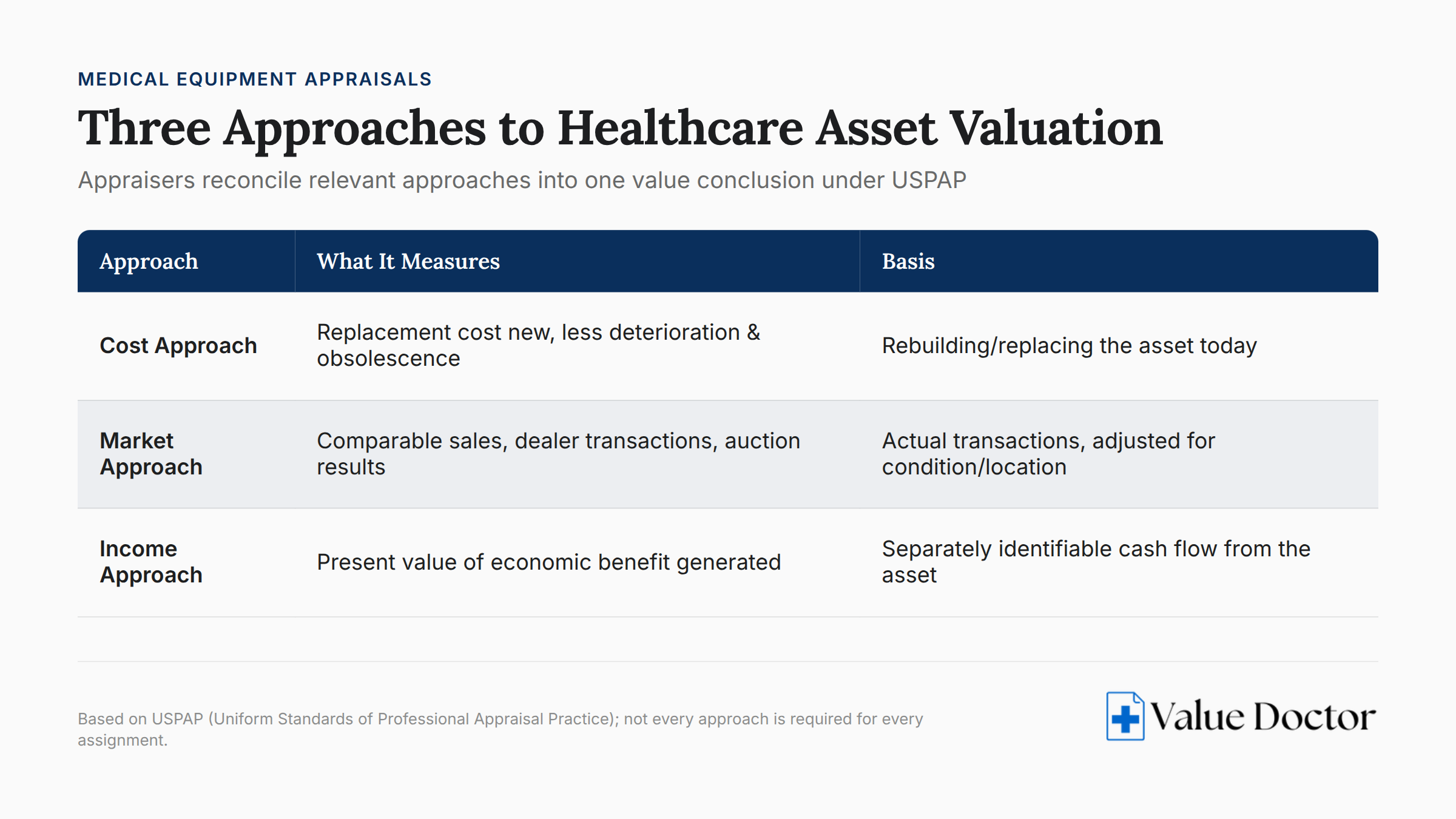
Appraisers typically develop value using up to three recognized approaches, reconciling them into a single conclusion:
- Cost approach: replacement cost new, reduced for physical deterioration and obsolescence.
- Market approach: comparison against actual sales, dealer transactions, and auction results for similar equipment, adjusted for condition, configuration, and location.
- Income approach: present value of the economic benefit the asset generates, used when equipment produces separately identifiable cash flow.
USPAP (the Uniform Standards of Professional Appraisal Practice) does not require every approach to be developed for every assignment; the appraiser determines which approaches are relevant to the intended use and explains any that are excluded.
When You Need a Healthcare Asset Appraisal
The real question isn't how much the equipment is worth in the abstract. It's whether a specific legal, tax, accounting, financing, or transaction requirement calls for an independent valuation, and whether the report's standard of value matches that requirement.
Financial Reporting and Purchase Price Allocation
When a healthcare entity is acquired, ASC 805 requires the acquirer to allocate the purchase price across identifiable assets, including equipment, at fair value as of the acquisition date. ASC 820 governs how that fair value is measured and disclosed. These assignments require a report built specifically for the accounting framework in use; a valuation prepared for tax or lending purposes typically won't satisfy an auditor unless the definitions and documentation conform to the applicable accounting guidance. Our medical equipment appraisal for financial reporting service is built around these requirements.
Mergers, Acquisitions, and Due Diligence
Health system mergers, physician practice acquisitions, and ambulatory surgery center transactions all involve equipment transferring between parties, often at a value that needs to withstand regulatory scrutiny. For transactions implicating the federal physician self-referral law, known as the Stark Law, fair market value analysis becomes especially important. Stark's implementing regulations distinguish an outright equipment purchase from an equipment rental, and the fair-market-value standard applied to each differs, as outlined in recent Stark Law regulatory guidance on fair market value and general market value. An appraisal supporting one of these transactions needs to state plainly whether it's valuing a purchase, a rental, or another economic interest.
Medicare Cost Reporting and Reimbursement
CMS guidance defines fair market value, for cost-reporting purposes, as the price an asset would bring through bona fide bargaining between well-informed, unrelated buyers and sellers at the date of acquisition, and treats comparable completed sales of like equipment as ordinarily relevant evidence of that value, per a Provider Reimbursement Review Board decision addressing fair market value. Separate CMS guidance addresses how fair market value applies when an asset is replaced and has no historical cost basis of its own, as described in a CMS transmittal on asset cost and reimbursement treatment. Matching the appraisal's effective date and asset grouping to the specific cost-reporting requirement is what makes the report usable.
Insurance Coverage and Claims
Insurance appraisals verify that scheduled values comply with policy requirements, and claims appraisals do the same work after a loss has already occurred. The standard applied, replacement cost new or actual cash value, needs to be stated explicitly rather than left implied, since the two can produce very different numbers for the same piece of equipment. Our medical equipment appraisal for insurance service covers both coverage-setting and post-loss claim scenarios.
Equipment Financing and Collateral
Asset-based lenders increasingly accept medical and diagnostic equipment as collateral, not just real estate. A collateral appraisal typically concludes orderly liquidation value, the proceeds a lender could reasonably expect from a structured sale with normal marketing time, which is a meaningfully different number from fair market value in continued use.
Charitable Donation Appraisals
Watch out: Donating a scanner, analyzer, or surgical instrument set without a qualified appraisal can jeopardize the entire deduction, not just reduce it.
Under federal tax rules, a noncash charitable contribution of equipment valued at more than $5,000 generally requires a qualified appraisal and completion of Section B of IRS Form 8283, subject to limited exceptions. Contributions over $500,000 generally require the appraisal itself to be attached to the return. At $5,000 or below, a qualified appraisal isn't required by that threshold alone, though the donor still needs to substantiate the value. These requirements come from the tax code and Treasury regulations, and the IRS publishes the current forms and thresholds that govern them. A report labeled "USPAP-compliant" isn't automatically sufficient for this purpose unless it also meets the specific tax-code definitions for a qualified appraisal and qualified appraiser.
Estate and Divorce Proceedings
Medical and dental practices that change hands through inheritance or divorce often include substantial equipment value that needs an independent, defensible number as of a specific date. These assignments typically conclude fair market value as of the date of death or the date of filing, and the report needs to withstand review by opposing counsel or a court.
Comparing Appraisal Purpose, Value Standard, and Who Typically Requests It
The table below summarizes how the standard of value and the typical requester shift depending on why the appraisal is being ordered.
| Appraisal Purpose | Standard of Value | Typical Requester |
|---|---|---|
| Financial reporting (ASC 820/805) | Fair value under the applicable accounting framework | CFO, controller, external auditor |
| M&A due diligence | Fair market value | Acquiring health system, investment bank, legal counsel |
| Insurance coverage and claims | Replacement cost new or actual cash value | Risk manager, insurance adjuster |
| Equipment financing or collateral | Orderly liquidation value | Lender, asset-based finance company |
| Charitable donation | Fair market value (IRS definition) | Donor, nonprofit recipient, CPA |
| Estate or divorce proceedings | Fair market value as of a specific date | Attorney, executor, divorcing spouse |
Key takeaway: The equipment doesn't change. The standard of value does, and picking the wrong one is the single most common reason a healthcare asset appraisal gets rejected by the party relying on it.
Getting the Right Report the First Time
A generic depreciation schedule or an online asking price rarely reflects what a specific MRI unit, lab analyzer, or surgical system is actually worth. Comparable evidence needs to match the equipment's model, condition, accessories, software version, and disposition assumption, not just its general category. Our appraisers hold credentials with organizations including the ASA, ISA, AAA, and CAGA, and every report we prepare is developed in accordance with USPAP and scoped to the specific intended use before work begins.
If you're not sure which standard of value your situation calls for, that's the first conversation worth having before the appraisal starts. Request a healthcare equipment appraisal and our team will scope the assignment to the purpose, timeline, and documentation your situation actually requires.
This article is provided for general informational purposes only and does not constitute legal, tax, or financial advice. Readers should consult a qualified attorney or CPA regarding their specific circumstances.