
Blog
Medical Equipment Appraisal Bankruptcy Requirements: What Trustees and Courts Expect
Bankruptcy appraisals for medical and diagnostic equipment follow different rules than a standard fair market valuation. Here's what trustees, courts, and counsel actually require: the right value standard, the right effective date, and the documentation that holds up at the 341 meeting.
A practice owner filing Chapter 7 rarely realizes that the appraisal they already have on file, the one prepared last year for insurance or for a loan, will not satisfy a trustee. Bankruptcy appraisals answer a narrower question than most equipment valuations: not "what would a willing buyer pay in the ordinary course of business," but "what will this equipment actually convert to, in this liquidation, on this timeline." That distinction drives everything else in the report.
This matters most for imaging and diagnostic equipment: MRI units, CT scanners, cath lab systems, and surgical platforms that carry six-figure book values but a very different resale reality once they leave a licensed facility. Our medical equipment appraisal for bankruptcy work exists specifically to bridge that gap between what a schedule says and what a trustee, secured lender, or judge needs to rely on.
The Value Standard Trustees Actually Need
Trustees generally need liquidation value, not fair market value, because their job is to determine whether equipment has equity above any liens and whether selling it will meaningfully benefit creditors. The U.S. Trustee Program's chapter 7 handbook directs trustees to administer and sell property only when a sale produces a meaningful distribution or some other real benefit to the estate, which means the trustee has to know what the equipment will actually bring at sale, not what it might be worth to a buyer in an unhurried, arm's-length transaction (U.S. Trustee Program chapter 7 handbook).
Fair market value assumes a reasonable exposure period, an informed buyer and seller, and no compulsion on either side. That assumption rarely holds in a bankruptcy estate. Equipment has to be de-installed, marketed to a much smaller secondary buyer pool, and sold within a timeline set by the case, not the market. A standard fair-market appraisal, run through those same fair-market assumptions, will overstate what the estate can actually recover and can mislead a trustee's decision about whether to sell or abandon an asset.
Forced vs. Orderly Liquidation Value
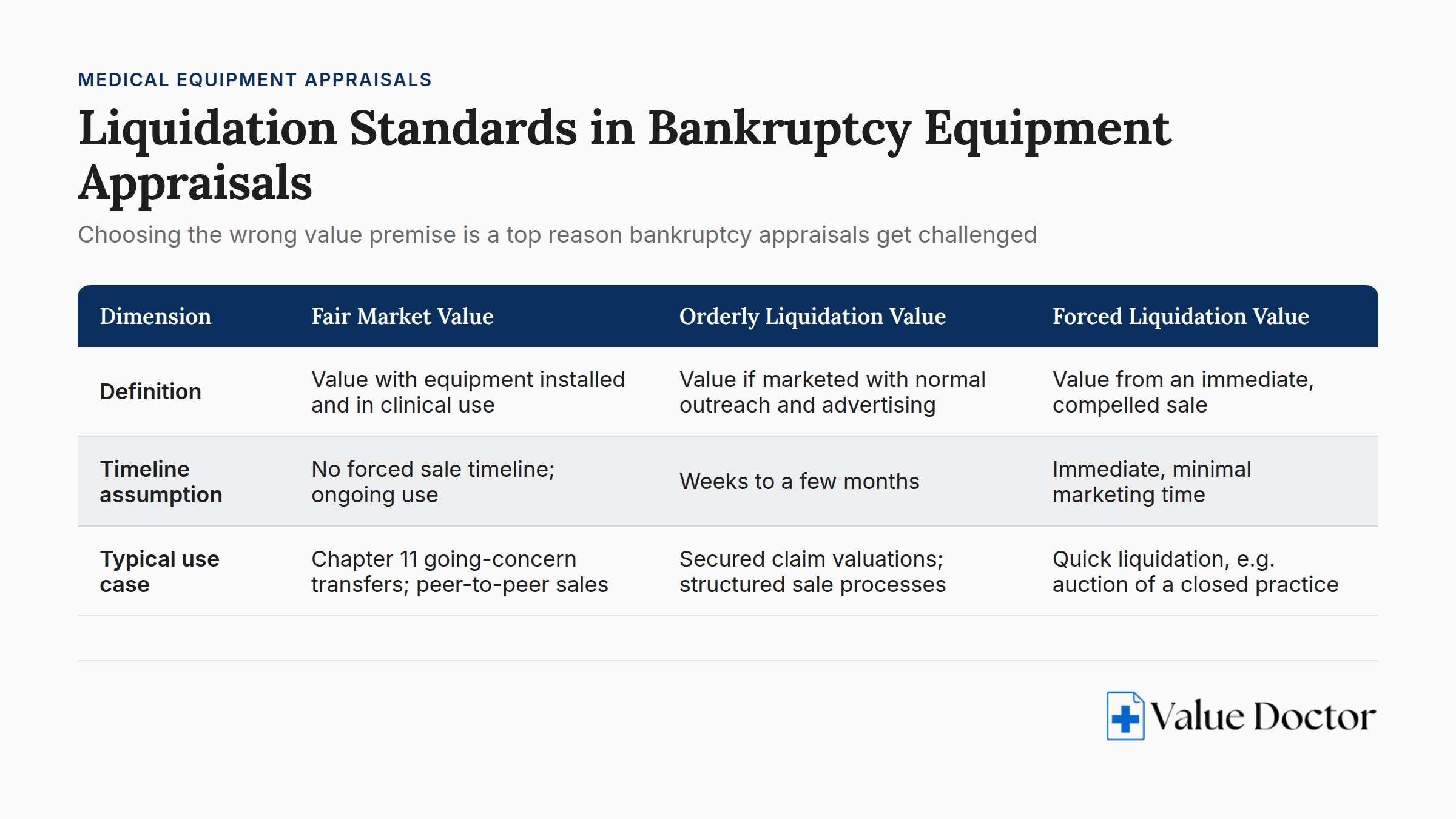
The two liquidation standards most often called for in bankruptcy are not interchangeable, and the appraiser needs to know which one applies before starting the assignment.
- Orderly liquidation value assumes the equipment is marketed and sold over a limited but reasonable period, typically weeks to a few months, with normal advertising and buyer outreach. This is the most common standard for secured claim valuations and for sales that go through a structured process.
- Forced liquidation value assumes an immediate, compelled sale, often at auction, with minimal marketing time and no ability to wait for the right buyer. This is the standard when equipment must be liquidated quickly, such as an auction of a closed practice's assets.
- Fair market value still has a role, mainly in Chapter 11 going-concern transfers or peer-to-peer sales between healthcare providers where the equipment stays installed and in clinical use.
Choosing the wrong premise is one of the most common reasons a bankruptcy appraisal gets challenged. An appraiser who defaults to fair market value out of habit, without confirming the intended use with the trustee or counsel first, produces a number the estate cannot actually rely on.
Timing: Why the Petition Date Drives the Appraisal Date
The appraisal's effective date should match the bankruptcy petition filing date, or fall as close to it as possible, because Schedule A/B requires the debtor to report asset values as of that filing date. An appraisal dated months before or after the petition creates a mismatch that a trustee, creditor, or opposing counsel can attack outright.
Timing matters procedurally too. Valuation documentation often needs to be in the trustee's hands before the Section 341 meeting of creditors, since that meeting is where the trustee questions the debtor about scheduled assets and their values. Waiting until after the meeting to produce a defensible appraisal puts the debtor and counsel in a weaker position, especially if the trustee has already flagged equipment values as inconsistent or unsupported.
Watch out: If a case has been pending for a while before an appraisal is ordered, request the actual petition date from counsel and use it as the effective date regardless of when the physical inspection happens. The inspection date and the effective date do not have to be identical, but the analysis needs to reconstruct value as of the petition date.
What the Report Needs to Document
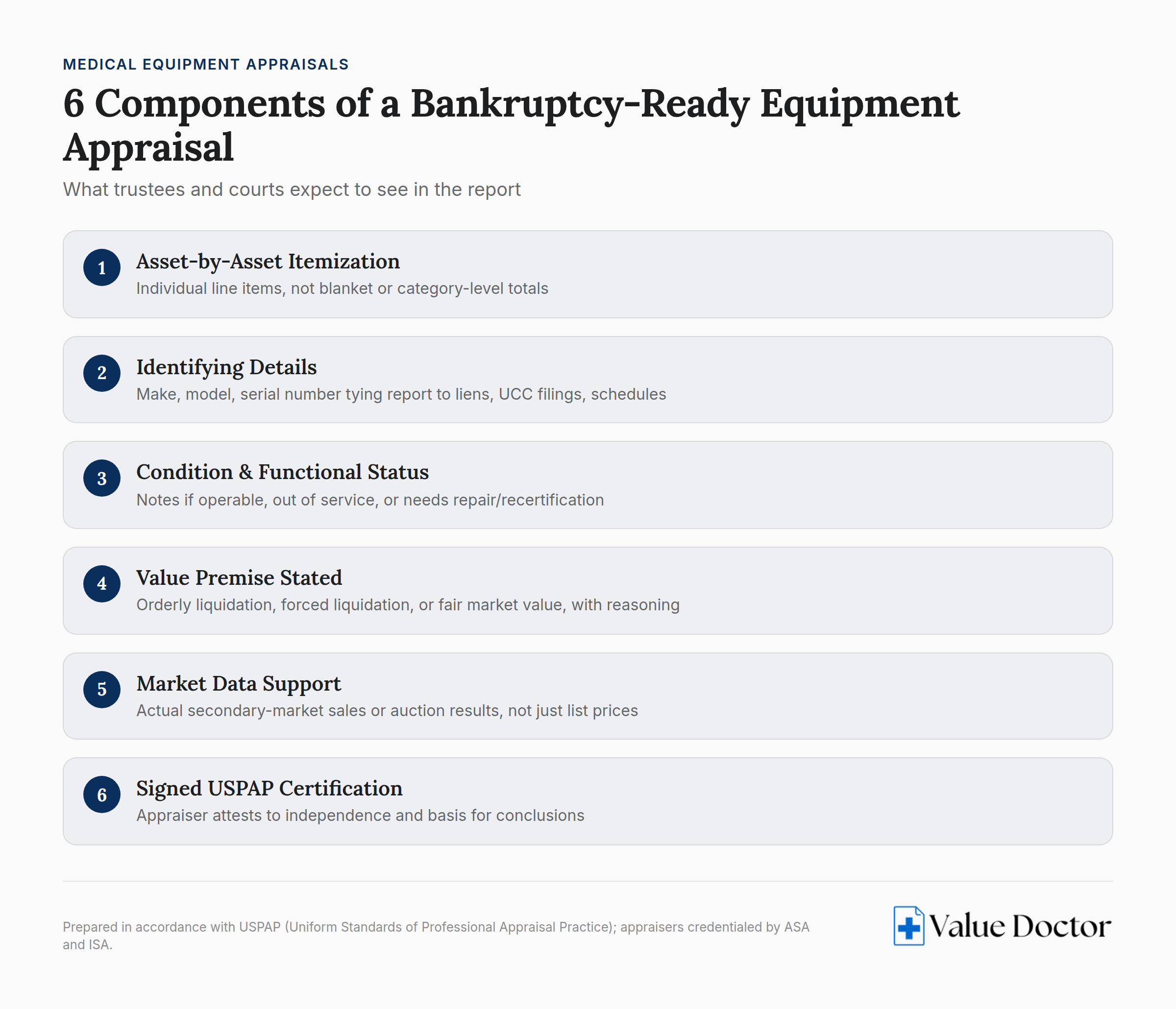
A bankruptcy-ready equipment appraisal needs to give a trustee everything necessary to defend the values if challenged, since courts and creditors will scrutinize a bankruptcy report far more closely than an insurance or donation appraisal. At minimum, the report should include:
- Asset-by-asset itemization rather than blanket or category-level totals, since trustees need to know what specific equipment carries the value.
- Identifying details for each item, including make, model, and serial number, so the report ties directly to lien filings, UCC financing statements, and the debtor's own equipment schedules.
- Condition and functional status, noting whether equipment is currently operable, out of service, or requires repair or recertification before resale.
- The value premise used and why, stating plainly whether the conclusion is orderly liquidation value, forced liquidation value, or fair market value, and the reasoning tied to the case's facts.
- Market data or comparable sales support, showing actual secondary-market transactions or auction results rather than list prices or depreciation tables alone.
- A signed appraiser certification, prepared in accordance with USPAP (Uniform Standards of Professional Appraisal Practice), stating the appraiser's independence and the basis for the conclusions.
Our appraisers hold credentials with organizations such as the ASA and ISA, and every bankruptcy report we prepare follows USPAP so it can withstand review by a trustee, opposing counsel, or the court itself.
Chapter 7 vs. Chapter 11: Confirm the Premise Before You Start
Chapter 7 liquidation and Chapter 11 reorganization can call for entirely different value premises, so the appraiser should confirm the intended use with the trustee or counsel before beginning the engagement rather than assuming.
In a straightforward Chapter 7 case, the trustee is typically deciding whether to sell equipment for the benefit of unsecured creditors or abandon it as burdensome, which calls for orderly or forced liquidation value depending on how quickly the sale needs to happen. In Chapter 11, the debtor may be reorganizing around a going concern and intends to keep operating equipment in place, which points toward fair market value or a value-in-use standard instead. A single case can even require both: liquidation value for equipment being sold off, and going-concern value for equipment the reorganized practice will keep.
This is also where court involvement changes the process. When a trustee retains the appraiser directly, the court generally has to approve both the engagement and the fee before work begins. When the debtor retains the appraiser independently, no court approval is required up front, though the resulting values can still be challenged later if creditors dispute them.
Example: Valuing Imaging Equipment for a Chapter 7 Practice Closure
Example: A diagnostic imaging practice files Chapter 7 with an MRI unit, a CT scanner, and an ultrasound suite on its books at a combined depreciated value of $410,000. The trustee needs to know what these assets will actually bring if sold to fund creditor distributions.
An appraiser confirms with the trustee that orderly liquidation value is the correct standard, since the equipment will be marketed to secondary buyers over a period of roughly 60 to 90 days rather than sold immediately at auction. The appraisal documents each unit by make, model, and serial number, notes that the MRI requires a service contract transfer and site de-installation, and supports its conclusion with recent secondary-market sales of comparable systems. The resulting orderly liquidation value comes in well below the depreciated book figure, largely because of de-installation costs, a thinner buyer pool for older MRI platforms, and the compressed marketing window. That number, not the balance sheet figure, is what the trustee uses to decide whether a sale is worth pursuing.
Common Mistakes That Undermine a Bankruptcy Appraisal
The same handful of errors show up repeatedly in contested bankruptcy cases involving medical equipment:
- Submitting a standard fair-market appraisal instead of a liquidation appraisal, which overstates recoverable value and invites a creditor challenge.
- Missing the petition-date timing, either by dating the report to the inspection date instead of the filing date or by delivering it after the 341 meeting has already occurred.
- Insufficient itemization on high-value imaging and diagnostic equipment, where a lump-sum category total leaves the trustee unable to tie specific units to lien filings or to defend the number if questioned.
- Failing to state the value premise explicitly, leaving the report open to the argument that the appraiser applied an inconsistent or undefined standard.
Key takeaway: A bankruptcy appraisal is judged on whether it can survive a challenge in court, not on whether the number looks reasonable on its face. Itemization, timing, and a clearly stated value premise are what make that possible.
Fees for Bankruptcy Equipment Appraisals
Bankruptcy engagements are quoted as a fixed fee after we scope the assignment, based on the number of assets, the complexity of the equipment involved, and the depth of documentation a trustee or court will require. As a general reference point, our medical equipment appraisals typically start at $295 for standard scope, with most engagements running $695 to $2,200, and complex assignments involving specialized imaging or diagnostic inventories running $5,000 to $10,000 or more. Fees are never billed hourly, and they are driven by the scope of the work, not by the value of the equipment being appraised.
If you are a trustee, attorney, or practice owner facing a Chapter 7 or Chapter 11 filing that includes medical or diagnostic equipment, our medical equipment appraisal for bankruptcy service is built around the timing and documentation standards courts actually require. Reach out before the petition is filed if possible, so the effective date and the filing date line up from the start.
This article is provided for general informational purposes only and does not constitute legal, tax, or financial advice. Readers should consult a qualified attorney regarding the specific requirements of their bankruptcy case.