
Blog
Medical Equipment Appraisal for Divorce Court: What Judges and Attorneys Expect From Your Report
A medical equipment appraisal for divorce court has to answer a question a standard appraisal never asks: which value definition does this jurisdiction actually require? This guide covers the documentation, USPAP standards, and expert-witness coordination that make a tangible-asset report hold up in family court.
When a marriage ends and the marital estate includes a medical, dental, or optometry practice, the equipment inside that practice often becomes one of the more contested line items on the balance sheet. A routine appraisal answers "what is this worth?" A divorce appraisal has to answer a harder question first: worth to whom, under what assumption, and according to whose definition? Getting that framing wrong is the single most common reason an equipment valuation gets challenged in court.
Why the Standard of Value Comes From the Court, Not the Appraiser
The most important decision in a divorce equipment appraisal is not the appraiser's to make. It belongs to the jurisdiction, and sometimes to the specific judge or the terms of a settlement agreement, and the appraiser's job is to find out what it is before the inspection even happens.
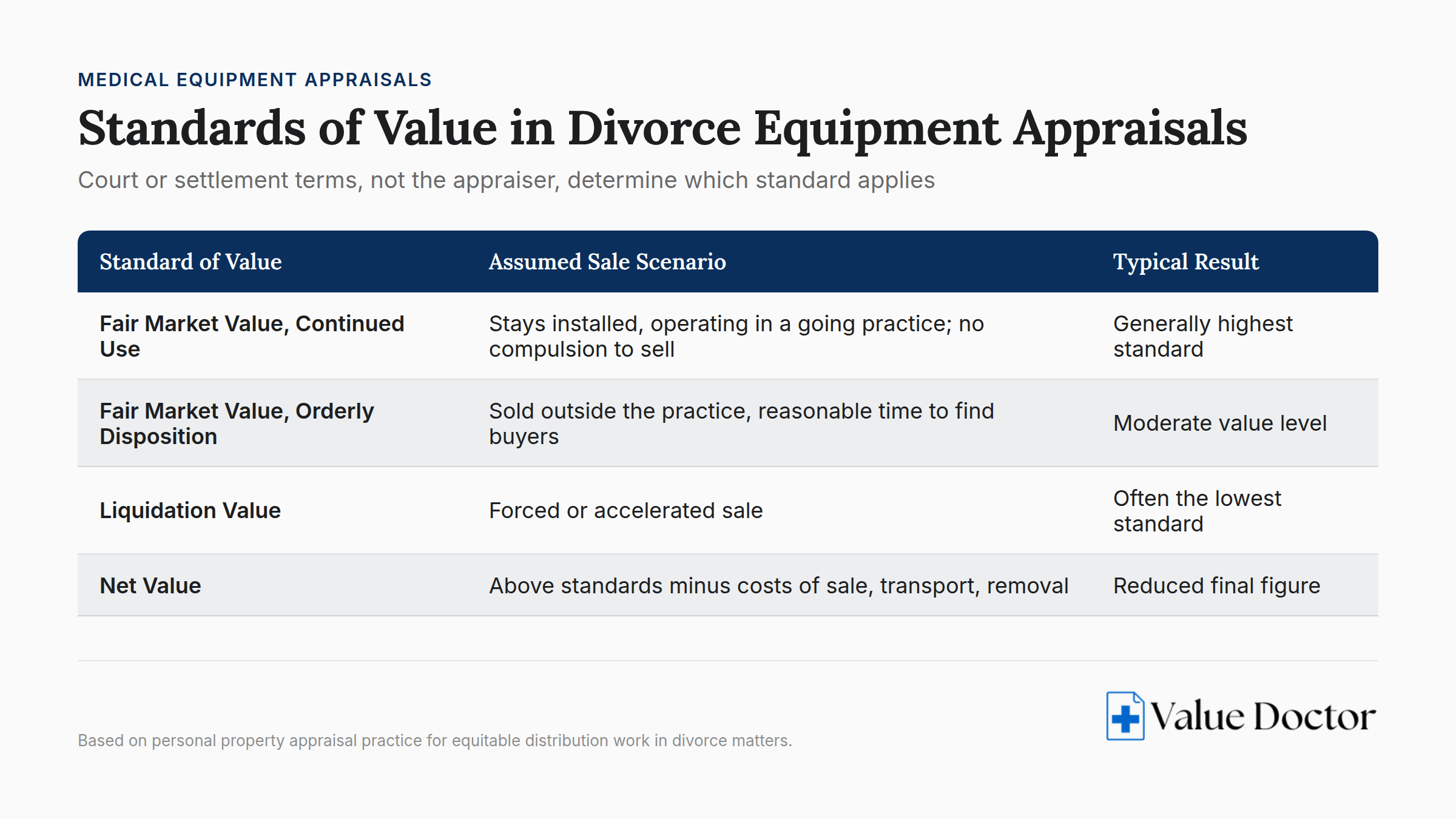
Personal property appraisal practice for equitable distribution work recognizes several distinct standards of value, and they are not interchangeable:
- Fair market value in continued use: the price a willing buyer would pay a willing seller assuming the equipment stays installed and operating as part of a going practice, with no compulsion to sell.
- Fair market value, orderly disposition: what the equipment would bring if sold with reasonable time to find buyers, outside the context of the practice.
- Liquidation value: what the equipment would bring in a forced or accelerated sale, often the lowest of the standards.
- Net value: a figure some jurisdictions require after deducting costs of sale, transportation, or removal.
A dental chair valued under continued-use assumptions and the same chair valued for liquidation can produce two very different numbers, and neither one is "wrong." They are answers to different questions. Because state law and local case precedent determine which standard applies to a marital estate, our appraisers get the value definition in writing from the retaining attorney or the client before scoping the engagement, and that definition goes into the report itself so opposing counsel cannot later argue the appraiser guessed at the premise. Our medical equipment appraisal for divorce engagements always start with that conversation, not with a walk-through.
Fair Market Value in Continued Use vs Liquidation Value: Why It Changes the Number
The gap between these two standards is not academic. It can shift a practice's tangible asset value by tens of thousands of dollars, which matters directly in an equitable distribution settlement.
Example: A dental practice owns an intraoral scanner purchased three years ago for $28,000. Valued in continued use, as a working part of an operating practice with a trained staff and an active patient base, the scanner might appraise around $16,000 to $18,000, reflecting normal depreciation but recognizing it functions as intended inside the practice. Valued for liquidation, as equipment pulled out and sold on the secondary market with no guarantee of a quick buyer, the same scanner might appraise closer to $8,000 to $10,000, once resale friction, shipping, recalibration, and a shrinking buyer pool are factored in.
Neither figure is inflated or conservative for its own sake. They are two legitimate answers to two different questions, which is exactly why the standard of value has to be settled and documented before the report is written, not argued about after opposing counsel receives it.
What Documentation Attorneys and Courts Expect to See
A report that states a value without showing its work rarely survives cross-examination. Courts and the attorneys who rely on these reports expect a documented, traceable chain from the physical asset to the concluded number.
At minimum, a defensible equipment appraisal for a divorce matter should include the following:
- A complete equipment inventory listing make, model, and serial number for every asset, not a generic category description like "exam room equipment."
- Depreciation schedules and fixed asset registers reconciled against current market data, so the court can see where book value and market value diverge and why.
- Purchase invoices, financing agreements, and equipment leases, which establish original cost, acquisition date, and whether the practice actually owns the equipment outright or is still paying it off.
- Condition documentation from a physical inspection, including photographs and notes on wear, maintenance history, and any equipment that has been serviced, upgraded, or partially replaced.
When a fixed asset register still carries a piece of equipment at a low depreciated book value while the same unit still commands strong resale demand (a common situation with X-ray units and sterilization equipment that hold value longer than their depreciation schedules suggest), the appraiser has to reconcile that gap in the report itself, not leave it for a judge to puzzle over. Attorneys who have been through this process before will ask about serial numbers and inspection dates before they ask about the final number, because that's what a challenge in deposition actually tests.
USPAP Standards 7 and 8: The Framework for Personal Property Litigation Work
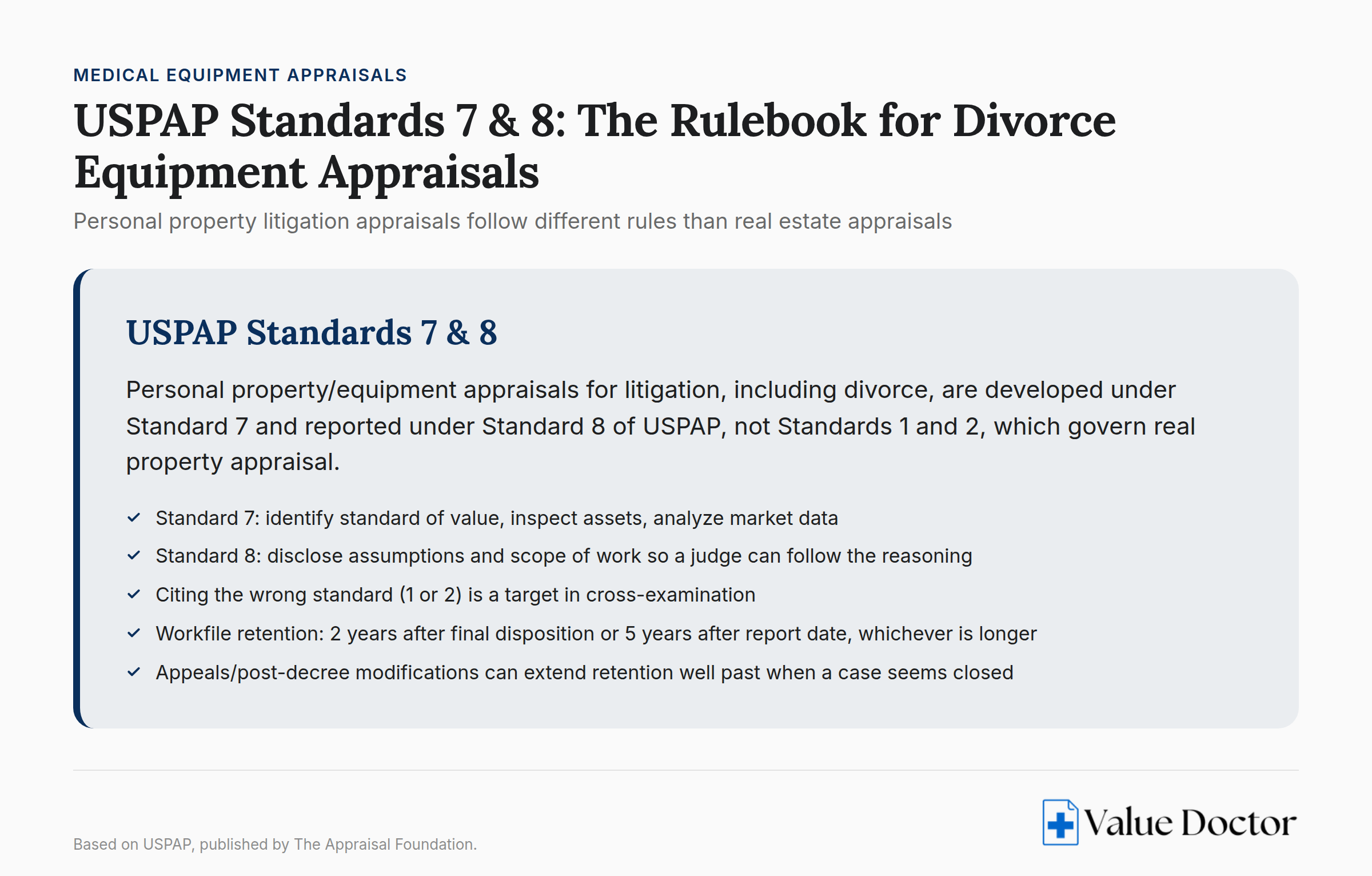
Personal property and equipment appraisals prepared for litigation, including divorce, are developed and reported under Standards 7 and 8 of the Uniform Standards of Professional Appraisal Practice, published by The Appraisal Foundation. That distinction matters because Standards 1 and 2 govern real property appraisal, a different discipline entirely, and a report that cites the wrong standard is an easy target in cross-examination.
Standard 7 governs how the appraiser develops the opinion of value: identifying the correct standard of value, inspecting the assets, and analyzing market data. Standard 8 governs how that opinion gets reported: what the document must disclose, how assumptions are stated, and how the appraiser's scope of work is described so a reader, including a judge who has never seen an equipment appraisal before, can follow the reasoning.
USPAP also sets workfile retention requirements that matter specifically in litigation. For any assignment involving testimony in a judicial proceeding, the appraiser must retain the workfile for at least 2 years after final disposition of the proceeding, or 5 years after the report date, whichever period is longer. In a divorce that drags through appeals or post-decree modifications, that retention window can extend well past when most people assume the case is closed, and it is one more reason the initial inspection and documentation need to be thorough the first time.
How the Equipment Appraiser Works With the Business Valuation Expert
Most contested practice divisions involve two separate experts, and confusing their roles is a common mistake. The business valuation expert values the practice as a whole, including goodwill, patient relationships, and earning capacity. The equipment appraiser values the tangible assets: the dental equipment, the optometry equipment, the imaging and sterilization systems, the furniture and fixtures.
These two figures feed into the same overall marital estate calculation, but they are not interchangeable and one expert should not attempt the other's analysis. A business valuation expert applying an income approach to the whole practice needs a reliable tangible asset number as an input, and a poorly supported equipment figure can undermine an otherwise sound business valuation report. Coordination between the two experts, without either one overstepping into the other's methodology, keeps both reports internally consistent when opposing counsel compares them line by line.
Our appraisers hold credentials with organizations including the ASA and ISA for personal property and machinery valuation, and every equipment appraisal is prepared in accordance with USPAP regardless of which standard of value the jurisdiction ultimately requires.
Getting the Standard of Value Right the First Time
A medical equipment appraisal for divorce court is quoted as a fixed fee after we scope the assignment, based on the number of assets, the completeness of existing records, and whether the report needs to meet a specific court deadline or deposition schedule; it is never billed by the hour. For a general medical equipment appraisal, published starting fees run from $295 for a standard report, with more complex practices involving larger equipment inventories or contested valuations typically falling in the $695 to $2,200 range.
The single most expensive mistake in this process is not a bad inspection or a missed invoice. It's skipping the conversation about which standard of value applies before the appraiser ever walks into the practice. Settle that question in writing with the attorney first, and the rest of the report has something solid to stand on.
This article is provided for general informational purposes only and does not constitute legal, tax, or financial advice. Readers should consult a qualified attorney or CPA regarding their specific circumstances.