
Blog
Cost, Market, or Income: Choosing the Right Medical Equipment Valuation Method
Medical equipment valuation methods fall into three USPAP-recognized approaches: cost, market, and income. This guide shows which one your appraiser will lean on based on your equipment type, available data, and the purpose of your appraisal.
Why Your Appraiser Doesn't Pick a Method at Random
Ask five practice owners how their imaging suite was valued and you'll likely get five different answers, because the right method depends on the equipment itself, not on habit. Medical equipment valuation methods break down into three recognized approaches: cost, market (sales comparison), and income. A qualified appraiser considers all three on every assignment, but only develops the ones that produce a credible, supportable number for that specific piece of equipment.
This matters because the method an appraiser emphasizes changes what documentation you need to gather and how long the engagement takes. Whether you're preparing for a practice sale, an insurance claim, an SBA loan, or an estate filing, understanding the three approaches ahead of time helps you anticipate what a medical machinery appraisal will actually look like. Our medical equipment appraisal team works through this same framework on every engagement, regardless of asset type.
USPAP Requires All Three Approaches Be Considered
Under the Uniform Standards of Professional Appraisal Practice, published by The Appraisal Foundation, an appraiser must consider the cost, market, and income approaches on every assignment. USPAP does not require that all three be developed into a final opinion of value; it requires that each be evaluated for relevance and that the appraiser explain why any approach was excluded.
In practice, this means a report on a used ultrasound machine might rely almost entirely on comparable sales data, while a report on a custom-built radiation therapy vault might rely almost entirely on replacement cost. Both reports can be equally credible. The difference is in which data was available and which approach that data could actually support.
Key takeaway: the appraiser's job is not to run all three formulas and average them. It's to determine which approach (or combination) the available evidence actually supports for your specific equipment.
The Cost Approach: Replacement Cost Less Depreciation
The cost approach starts with the replacement cost new of an asset and subtracts value lost to depreciation and obsolescence. The IRS describes this approach as measuring value based on the cost to replace or reproduce an asset, less an allowance for physical deterioration or obsolescence, a definition that applies directly to medical equipment used in practice or hospital settings (IRS).
A cost approach calculation typically works through three layers of loss:
- Physical deterioration: wear from age and use hours, tracked against the equipment's expected service life.
- Functional obsolescence: a loss in value because a newer model does the same job faster, with lower operating costs, or with features the subject unit lacks.
- Economic obsolescence: external factors, like a reimbursement change or a shift in patient volume, that reduce the equipment's usefulness independent of its physical condition.
The cost approach tends to carry the most weight when the equipment is new or custom-configured, such as a recently installed cath lab build-out, where there's little resale history to draw comparable data from. It's also the fallback approach for highly specialized or facility-specific installations where no active secondary market exists.
The Market Approach: What Comparable Equipment Actually Sold For
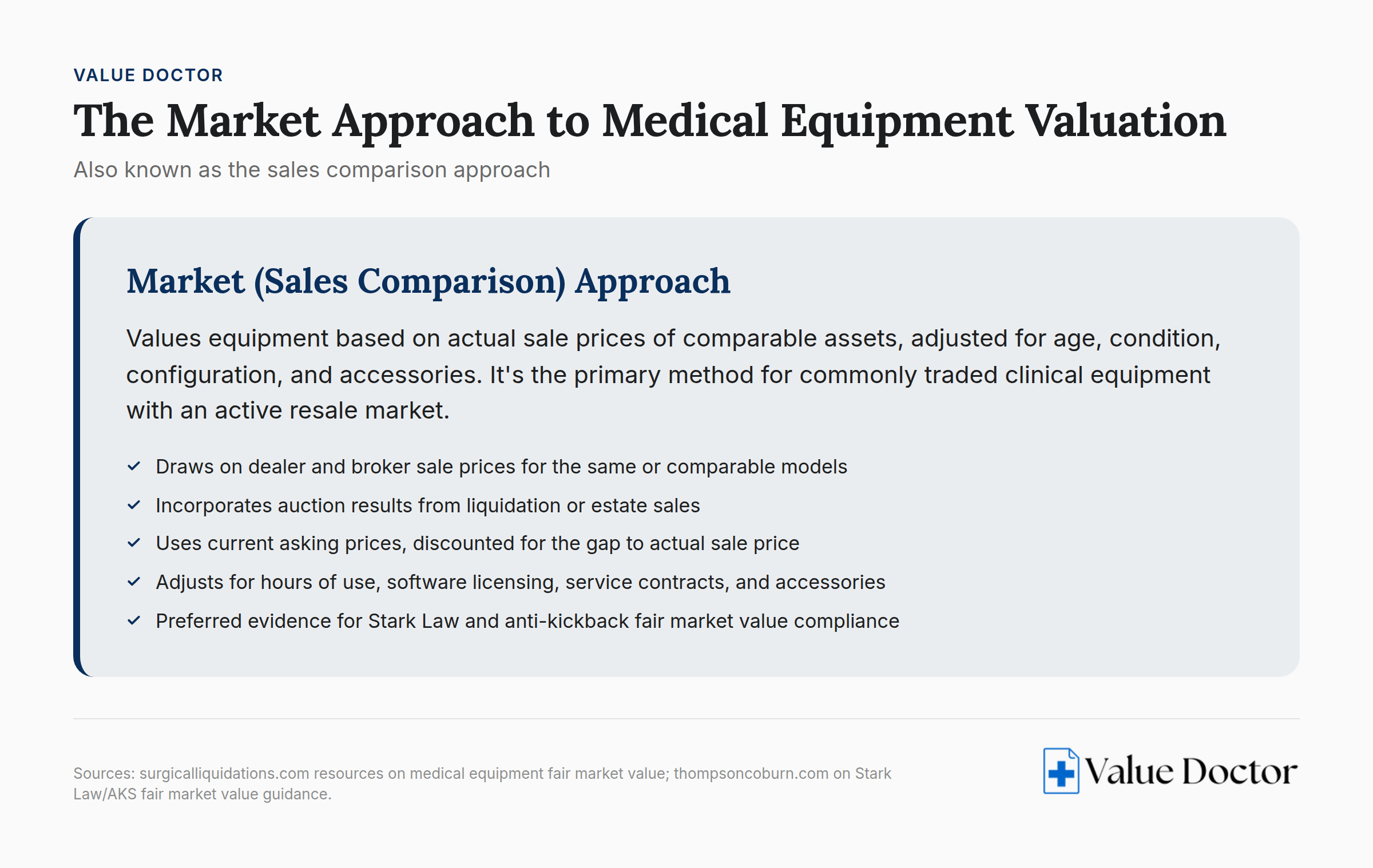
The market approach, also called the sales comparison approach, values equipment based on actual transactions involving similar assets, adjusted for differences in age, condition, configuration, and included accessories. Industry appraisal sources describe fair market value for medical equipment as being established through comparable sales of similar equipment in similar condition, often the most reliable indicator for commonly traded clinical assets (surgical equipment valuation resources).
A credible market approach draws on:
- Dealer and broker sale prices for the same or a closely comparable model.
- Auction results for equipment sold at liquidation or estate sales.
- Current asking prices, adjusted downward for the gap between list price and actual negotiated sale price.
- Adjustments for hours of use, software licensing, service contracts, and included accessories.
This approach carries the most weight for standard, commonly traded equipment: patient monitors, anesthesia machines, dental chairs, basic ultrasound units, autoclaves, and similar assets with an active resale market. Because the evidence comes from real transactions, the market approach also tends to be the preferred support for fair market value determinations tied to physician self-referral and anti-kickback compliance, where regulators expect an arm's-length, verifiable number rather than an internal estimate (Stark Law and AKS fair market value guidance).
The Income Approach: Present Value of Equipment-Specific Cash Flow
The income approach values an asset based on the present value of the future economic benefit it generates, typically calculated through discounted cash flow or capitalization of earnings. Fair value accounting guidance describes this as the "mark-to-model" approach, distinct from cost-based and market-based methods (fair value measurement framework).
For individual pieces of medical equipment, this approach is used selectively, and for a practical reason: it's genuinely difficult to isolate the income attributable to one machine from the income generated by the practice as a whole. A patient rarely pays a fee for "use of the MRI"; they pay for a procedure that involves the physician, staff, facility overhead, and the equipment together.
The income approach becomes relevant in narrower situations:
- Major imaging or treatment systems that clearly drive an identifiable, separately billable revenue stream, such as an MRI or PET scanner with trackable procedure volume and reimbursement rates.
- Whole service lines, like a cath lab or surgical suite, valued as an integrated income-producing unit rather than as individual devices.
- Entire practices or device companies, where capitalization of earnings or discounted cash flow is standard practice, and equipment value is embedded in a broader business valuation rather than appraised as a standalone line item (medical device company valuation methods).
Watch out: if an appraisal report leans heavily on an income approach for a single, ordinary piece of clinical equipment, ask how the appraiser isolated that equipment's cash flow from the rest of the practice's revenue. That separation is the hardest part of this approach to support credibly.
Comparing the Three Approaches Side by Side
The table below summarizes when each approach carries the most weight, what data it requires, and where its limitations show up.
| Approach | Best Used For | Key Data Needed | Main Limitation |
|---|---|---|---|
| Cost | New, custom-built, or highly specialized equipment with no active resale market | Current replacement cost, age, service life, condition, obsolescence factors | Doesn't reflect actual buyer demand; can overstate value for equipment nobody wants used |
| Market | Standard, commonly traded equipment (monitors, dental chairs, ultrasound units, autoclaves) | Comparable sale prices, dealer quotes, auction results, condition adjustments | Requires enough recent comparable transactions to be reliable; thin for rare or niche equipment |
| Income | Major imaging/treatment systems with trackable procedure revenue, or whole service lines and practices | Procedure volume, reimbursement rates, projected cash flow, discount rate | Hard to isolate equipment-specific income from overall practice revenue |
Anticipating Which Approach Your Appraiser Will Emphasize
You can generally predict which approach will carry the most weight in your report by looking at three factors before the engagement even starts.
Equipment type is the first signal. Commoditized clinical equipment (monitors, basic imaging, dental and lab devices) tends to pull toward the market approach because comparable sales data exists. Custom installations and newer, specialized systems pull toward the cost approach because there's little resale history to draw on. Large imaging or treatment systems with clear, trackable procedure revenue can pull toward the income approach, though usually only as a cross-check against the other two.
Availability of market data is the second signal. If your appraiser can find several verifiable recent sales of comparable equipment, the market approach becomes the anchor. If the equipment is rare, region-specific, or was purchased under a custom configuration, the appraiser will lean on cost data instead.
Intended use of the appraisal is the third, and often decisive, signal:
- Financing or collateral: lenders typically want market-supported value they can liquidate against if needed.
- Insurance coverage or claims: replacement cost (the cost approach) is usually the relevant standard, since the goal is restoring the insured to their prior position.
- Practice sale: a blend of market data on the hard assets and income analysis on the practice as a whole is common.
- Estate or tax filings: fair market value, generally market-supported where data exists, cost-supported where it doesn't.
- Litigation: appraisers often reconcile more than one approach to withstand cross-examination on methodology.
Pro tip: when you request an appraisal, tell the appraiser the intended use up front. It changes which data they'll ask you for and which approach they'll lean on to answer the question you actually need answered.
Reconciling More Than One Approach
Most credible medical equipment appraisals don't rely on a single approach in isolation. An appraiser might develop both the cost and market approaches on a mid-life imaging system, then reconcile the two indications into a single supported value, explaining any gap between them. That reconciliation, not the raw formula, is where an appraiser's judgment and experience actually show up in the report.
Appraisers holding credentials with organizations such as the ASA, CAGA, and ISA are trained specifically in this reconciliation process: weighing which indication of value deserves more reliance given the quality and quantity of supporting evidence. A report that shows its work on all three approaches, and explains why one was given more weight than another, tends to hold up better under scrutiny from lenders, insurers, courts, and tax authorities alike.
Getting a Defensible Number for Your Equipment
The method matters less than the reasoning behind it. A well-supported cost approach on a custom surgical suite is just as credible as a well-supported market approach on a used patient monitor, provided the appraiser explains why that approach fits the asset and the assignment. If you're preparing for financing, an insurance claim, a practice sale, or an estate filing, our medical machinery appraisal team can scope the right combination of approaches for your specific equipment and provide a USPAP-compliant report built for its intended use.
This article is provided for general informational purposes only and does not constitute legal, tax, or financial advice. Readers should consult a qualified attorney or CPA regarding their specific circumstances.