
Blog
9 Factors That Determine Value in a Medical Supplies and Equipment Appraisal
Every medical supplies appraisal rests on the same handful of value drivers, from condition and market demand to regulatory status and documentation. This guide ranks the factors that matter most and shows how the right emphasis shifts depending on whether the appraisal is for insurance, donation, estate, resale, or financial reporting.
A medical supplies appraisal covers a wider range of assets than most people expect: imaging systems, surgical instruments, diagnostic devices, and even bulk disposables and consumables. Each of those categories behaves differently in the market, and the same piece of equipment can carry a different value depending on why it's being appraised. Below are the factors our appraisers weigh most heavily, followed by how each appraisal purpose changes what matters.
The Top Factors That Drive Value
Condition and Usage History. A device's physical condition, calibration status, and how heavily it was used matter more than its list price ever did. An MRI unit that ran three shifts a day for a decade carries different value than one used part-time in a small practice, even if both are the same model year.
Age and Remaining Useful Life. Medical equipment depreciates on a curve tied to both physical wear and the pace of technology change in that specific category. A five-year-old ultrasound machine may still have significant remaining useful life, while a five-year-old point-of-care diagnostic unit in a fast-moving category may already be functionally obsolete.
Market Demand and Comparable Sales. Value ultimately traces back to what real buyers pay for comparable assets in an active secondary market. Our appraisers research recent transaction data, dealer listings, and auction results specific to the asset category rather than relying on generic depreciation tables.
Regulatory and Compliance Status. FDA clearance status, recall history, and whether an asset can still be legally resold or operated all affect value directly. A device pulled into a recall or missing required documentation may have little to no resale value regardless of its physical condition.
Completeness of Sets and Accessories. Surgical instrument sets, imaging systems with specialized coils or probes, and diagnostic devices with proprietary accessories lose value fast when pieces go missing. A complete, matched set is worth substantially more than the sum of its individual components sold separately.
Documentation and Maintenance Records. Service logs, calibration certificates, and proof of manufacturer-authorized maintenance support a higher, more defensible value conclusion. Missing documentation doesn't just create uncertainty; it can be treated as a red flag by buyers and reviewing agencies alike.
Asset Type: Capital Equipment vs. Consumables. Capital equipment (imaging systems, surgical tables, sterilizers) is valued item by item or in defined lots. Disposables and consumables, by contrast, are typically valued by category and unit count, since individual items rarely carry meaningful standalone value; our medical inventory appraisal work handles this distinction directly.
Intended Use of the Appraisal. The same asset can support different value conclusions depending on whether the report is for insurance replacement cost, a charitable donation deduction, an estate filing, or a resale decision. This is often the single biggest factor reshaping a valuation, and it's covered in detail below.
Credentialed Methodology and Approach to Value. How the appraiser selects and applies a valuation approach, and whether that approach is properly documented, determines whether a report will hold up under IRS review, in court, or with an insurer's claims desk.
Pro tip: Gather maintenance logs, purchase invoices, and any FDA correspondence before your appraiser's site visit. Complete records shorten the engagement and support a stronger, more defensible value conclusion.
How the Purpose of your Appraisal Changes What Matters
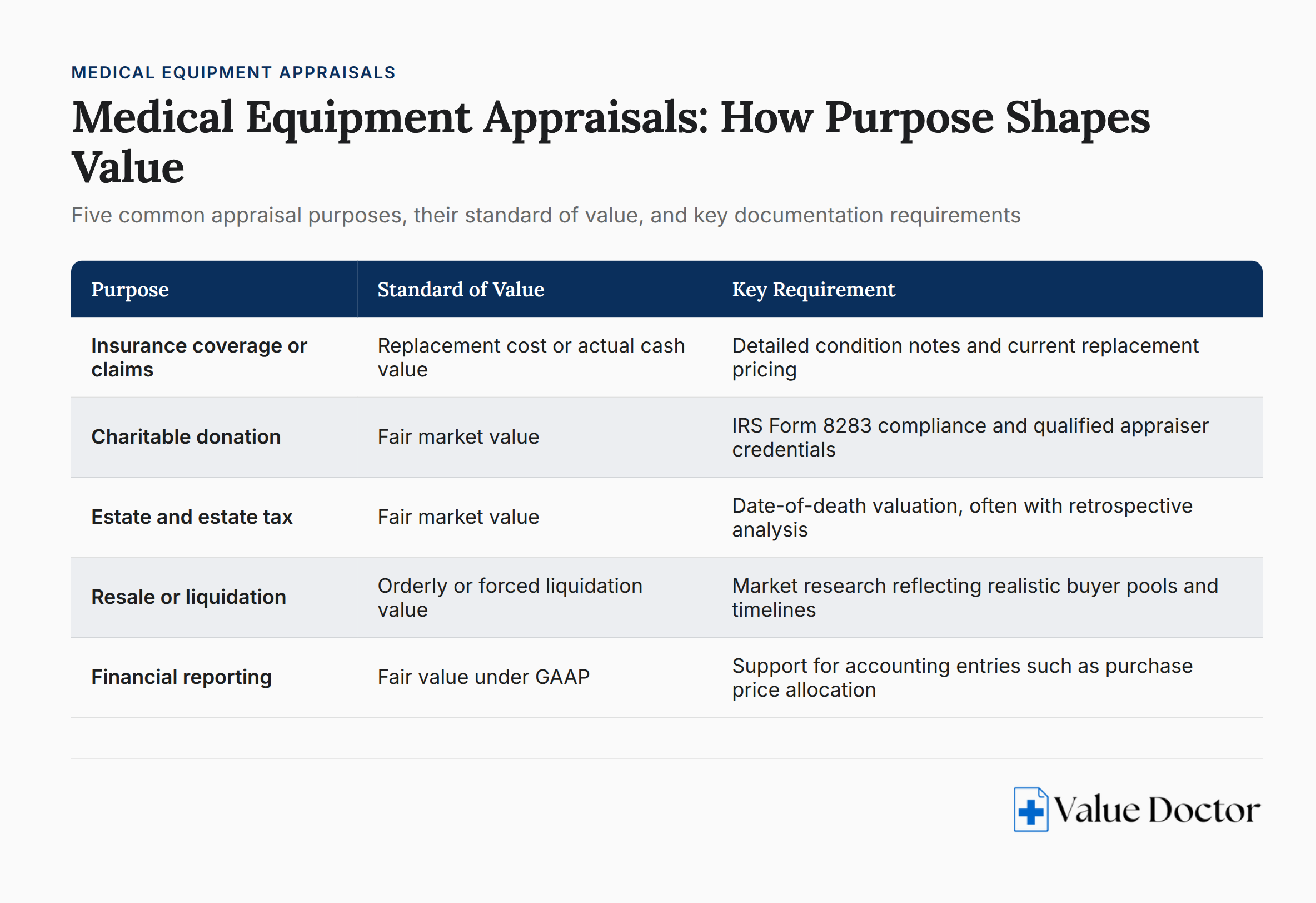
The intended use of a medical supplies appraisal determines which standard of value applies and which supporting documentation the report must include. The table below outlines the five most common purposes we're asked to support.
| Purpose | Standard of Value | Key Requirement |
|---|---|---|
| Insurance coverage or claims | Replacement cost or actual cash value | Detailed condition notes and current replacement pricing |
| Charitable donation | Fair market value | IRS Form 8283 compliance and qualified appraiser credentials |
| Estate and estate tax | Fair market value | Date-of-death valuation, often with retrospective analysis |
| Resale or liquidation | Orderly or forced liquidation value | Market research reflecting realistic buyer pools and timelines |
| Financial reporting | Fair value under GAAP | Support for accounting entries such as purchase price allocation |
Insurance Coverage and Claims
Insurance appraisals typically call for replacement cost or actual cash value, depending on the policy language, and the report needs to reflect current market pricing for equivalent equipment rather than depreciated book value. For a full breakdown of how this works for hospitals and practices, see our medical equipment appraisal for insurance guidance.
Charitable Donation
Donations of medical equipment or supplies to a hospital, teaching institution, or nonprofit clinic trigger specific IRS reporting rules tied to dollar thresholds. A donor generally must file Form 8283 for any noncash donation over $500, and a qualified appraisal prepared by a qualified appraiser is required once a single item or group of similar items exceeds $5,000 in claimed value. Our medical equipment appraisal for charitable donation work is built around meeting those exact requirements.
Estate and Estate Tax
Estate appraisals require a fair market value conclusion as of the date of death, which sometimes means researching a market that has since shifted. This retrospective element makes documentation and comparable sales research especially important, since the appraiser is reconstructing value for a point in time rather than the present.
Resale and Liquidation
Resale and liquidation appraisals ask a different question: what will this equipment actually bring in a realistic sale, given the buyer pool and timeline available? Orderly liquidation value assumes a reasonable sales period; forced liquidation value assumes a compressed timeline, and it typically produces a lower number.
Financial Reporting
Financial reporting appraisals, including purchase price allocations after a merger or acquisition, follow fair value concepts under generally accepted accounting principles. These engagements often require closer coordination with a client's accounting team than other appraisal purposes, since the value conclusion feeds directly into the balance sheet.
Why USPAP Requires Considering All Three Approaches
The Uniform Standards of Professional Appraisal Practice (USPAP) requires an appraiser to consider the cost approach, the sales comparison (market) approach, and the income approach for every assignment, even when only one or two are ultimately applied. For most medical equipment and supplies appraisals, the sales comparison approach carries the most weight, since active secondary markets exist for imaging systems, surgical tools, and diagnostic devices.
The cost approach (replacement cost new, less depreciation) becomes more useful for highly specialized or custom-installed equipment where comparable sales data is thin. The income approach is rarely the primary method for medical equipment itself, but it can matter when the asset is bundled into a larger income-producing operation, such as a diagnostic imaging center being valued as part of a business. A properly documented report explains why each approach was used, minimized, or set aside; that reasoning is part of what makes a report defensible.
Watch out: A report that only mentions one approach without explaining why the other two weren't applicable is missing a required element of USPAP compliance, not just a formality.
Who Should Perform a Medical Supplies Appraisal
Our appraisers hold credentials with organizations such as the American Society of Appraisers (ASA) and the International Society of Appraisers (ISA), and every report we prepare is written in accordance with USPAP. For charitable donation appraisals, the IRS has specific requirements for who qualifies to sign the report, and credentials from a recognized professional appraisal organization are part of meeting that bar.
Key takeaway: The credential matters less than the documented methodology behind it. A report that walks through the relevant approaches to value, cites real comparable data, and explains its reasoning is what actually holds up under review, whether the reviewer is an IRS agent, an insurance adjuster, or a judge.
What a Medical Supplies Appraisal Costs
Fees for medical equipment appraisals are quoted as a fixed fee after we scope the assignment, never billed hourly. Standard reports for medical equipment typically start at $295, with IRS-qualified reports (needed for charitable donation filings above the $5,000 threshold) starting at $395. Most engagements fall between $695 and $2,200, and the highest-complexity assignments, such as large hospital systems appraising extensive imaging fleets, can run from $5,000 to $10,000 or more.
What drives the fee is scope: the number of assets, the completeness of the records provided, whether the report needs to be IRS-qualified, and the depth of market research required. Value characteristics like a device's age or condition affect the concluded value, not what the appraisal costs to prepare.
A medical supplies appraisal only does its job when it's built around the right factors for the right purpose. Getting the standard of value, the documentation, and the methodology right the first time saves everyone, the donor, the estate, the insurer, or the accounting team, from having to redo the work later.
This article is provided for general informational purposes only and does not constitute legal, tax, or financial advice. Readers should consult a qualified attorney or CPA regarding their specific circumstances.