
Blog
What Counts as a Qualified Appraiser for a Medical Equipment Donation?
The IRS has specific rules for who can sign off on a medical equipment donation appraisal. Here's how to confirm your appraiser meets the qualified appraiser standard before you claim a deduction over $5,000.
If you're donating an imaging system, surgical unit, or a fleet of hospital beds and claiming a deduction above $5,000, the IRS doesn't just want a dollar figure. It wants that figure signed by someone who meets a specific legal definition of "qualified appraiser," and it disqualifies a long list of people you might otherwise ask. This guide walks through who qualifies, who's excluded, when the appraisal requirement kicks in, and which credentials actually matter for a medical equipment donation appraisal.
What Does "Qualified Appraiser" Mean Under IRS Rules?
A qualified appraiser is an individual, not a firm, who either holds an appraisal designation from a recognized professional organization or has met specific education and experience requirements for valuing the type of property in question, and who regularly performs appraisals for a fee. For medical equipment, that means someone with verifiable background in valuing clinical and diagnostic assets, not a generalist who typically appraises real estate or household goods.
The appraiser must also include a signed declaration in the report stating that, based on their background, experience, education, and professional memberships, they are qualified to value the specific type of property being appraised, as described in IRS Publication 561. That declaration isn't a formality. It's the mechanism the IRS uses to tie the appraiser's stated competence to the actual asset being donated.
Key takeaway: A credential alone doesn't make someone a qualified appraiser for your donation. The credential has to match the property type, and the appraiser has to be independent of the transaction.
Who Is Excluded From Serving as Your Appraiser?
The regulations disqualify certain people outright, regardless of how experienced they are. Under the rules governing qualified appraisals, as detailed in Treasury Regulation 1.170A-13(c), the following individuals cannot serve as your qualified appraiser:
- The donor making the contribution, or the taxpayer claiming the deduction.
- The donee organization receiving the equipment.
- A party to the transaction in which the donor acquired the property, unless the donation occurs within two months of acquisition and the appraised value doesn't exceed the acquisition price.
- Anyone employed by, married to, or related to the donor, the donee, or a party to the acquisition.
- Someone who regularly performs a majority of their appraisals for the donor and doesn't perform the majority of their appraisal work for other clients.
- Anyone barred from practicing before the IRS under the rules in 31 U.S.C. § 330(c) during the period the appraisal is prepared.
Fee structure matters too. An appraisal fee generally cannot be based on a percentage of the appraised value or the size of the resulting deduction. An appraiser who proposes a contingent or percentage-based fee has disqualified themselves before the engagement even starts.
When Does the IRS Require a Qualified Appraisal (and By When)?
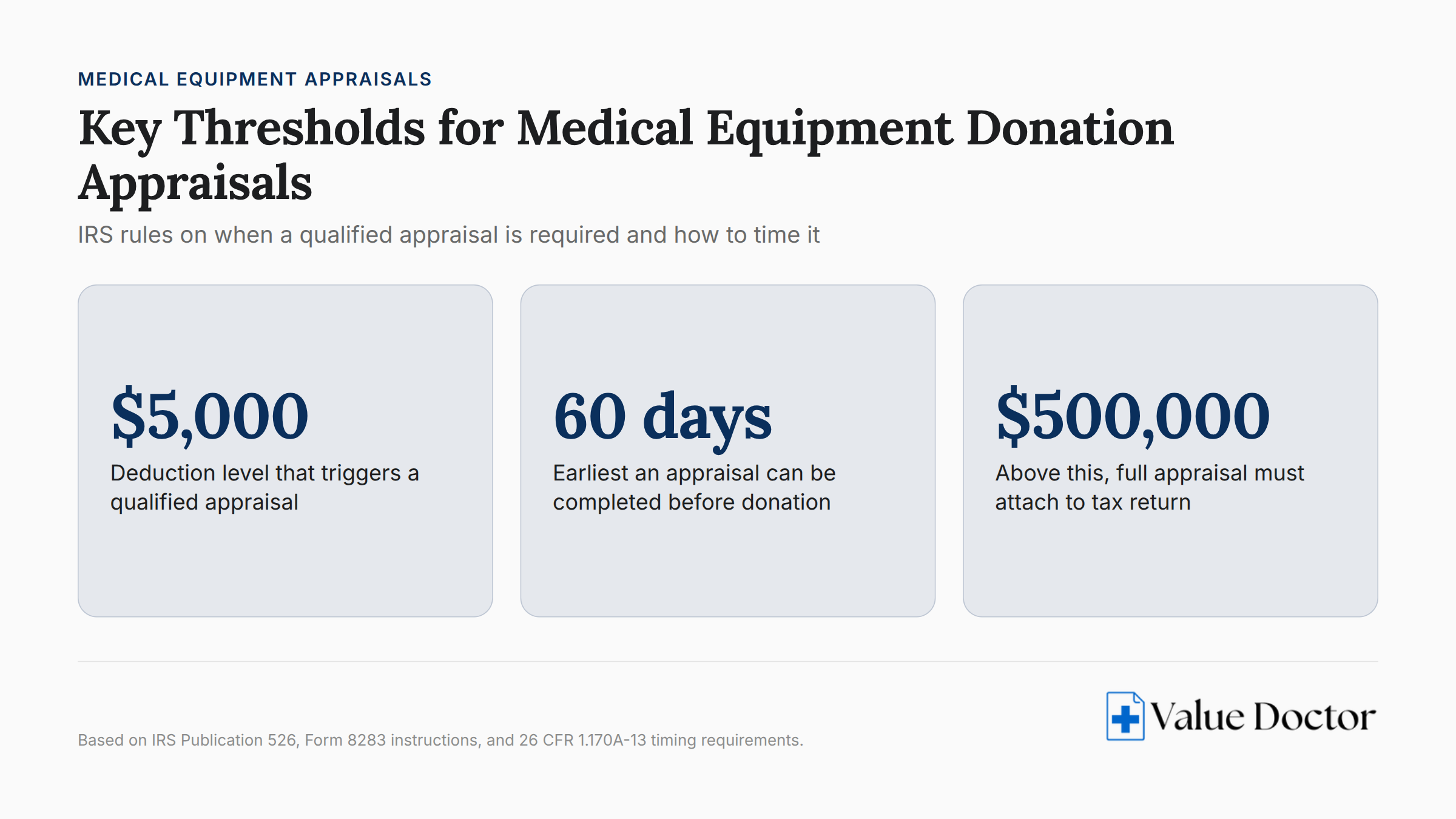
The qualified appraisal requirement applies once the claimed deduction for an item, or a group of similar items, exceeds $5,000. Below that threshold, you generally need a receipt and, for gifts of $250 or more, a contemporaneous written acknowledgment from the recipient, as outlined in IRS Publication 526, but a formal qualified appraisal isn't required.
Once you cross the $5,000 mark, the appraisal has to be completed within a defined window: no earlier than 60 days before the contribution date, and no later than the due date (including extensions) of the return on which the deduction is first claimed, per the timing requirements in the federal regulations. Donations claimed at more than $500,000 carry an additional requirement: the full qualified appraisal, not just the summary, must be attached to the return, as specified in the current Form 8283 instructions.
Form 8283 itself is an appraisal summary, not the appraisal. The underlying report has to exist independently, describe the equipment's condition, age, and valuation method, and carry the appraiser's signature. We've broken down exactly how to complete that form in our guide to Form 8283 for medical equipment donations.
Which Credentials Actually Matter for Medical Equipment?
No single credential automatically qualifies someone to appraise every type of medical equipment, and no single appraiser on our team holds every designation available. What matters is that the credential and experience line up with the asset category, and that the work is prepared in accordance with the Uniform Standards of Professional Appraisal Practice (USPAP), the standard published by The Appraisal Foundation.
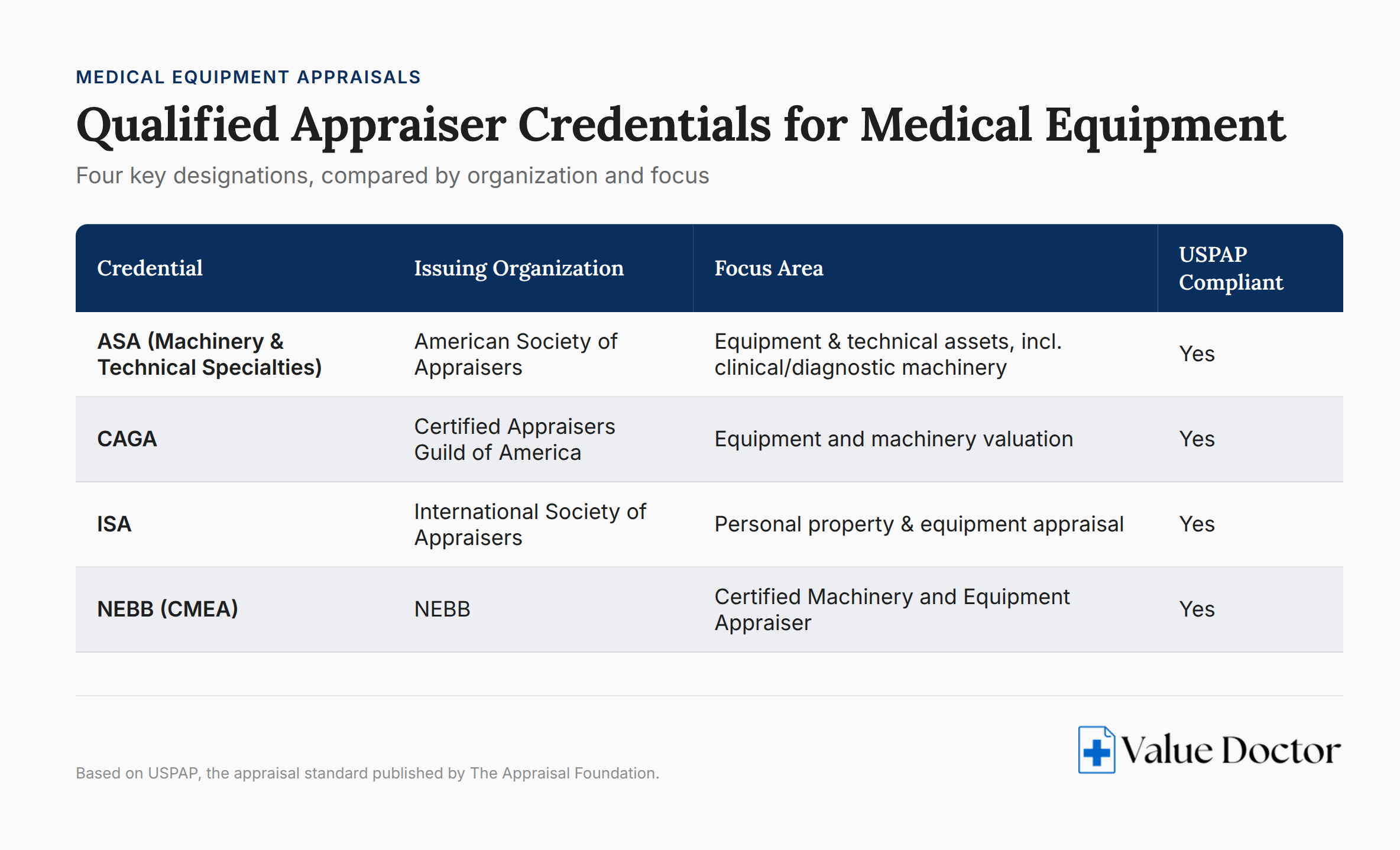
For medical and clinical equipment specifically, the credentials that carry the most weight include:
- ASA (Machinery and Technical Specialties): American Society of Appraisers designation covering equipment and technical asset valuation, including clinical and diagnostic machinery.
- CAGA: Certified Appraisers Guild of America credentialing, commonly referenced for equipment and machinery valuation work.
- ISA: International Society of Appraisers designation, generally associated with personal property and equipment appraisal practice.
- NEBB (CMEA): Certified Machinery and Equipment Appraiser credentialing through NEBB, specific to machinery and equipment valuation.
Our appraisers hold credentials with organizations such as ASA, CAGA, ISA, and NEBB, and every report we prepare is built to be consistent with USPAP. When you're vetting a candidate, ask which credential they hold, how it applies to the specific equipment category you're donating (an MRI suite is not the same valuation problem as a set of exam tables), and how many years of relevant experience back it up.
Red Flags That Signal an Appraiser Isn't Qualified
A few warning signs show up repeatedly when donors end up with a report the IRS won't honor.
Watch out: If an appraiser proposes a fee tied to a percentage of the appraised value, walk away. That fee structure disqualifies the appraisal outright under federal rules, no matter how credentialed the appraiser otherwise is.
Other signals worth taking seriously:
- The appraiser can't name a specific credential or professional membership relevant to medical equipment, and instead points to general experience as a reseller or technician.
- The report makes no reference to USPAP or any recognized appraisal standard.
- The appraiser has a financial relationship with the donor, the recipient charity, or the party who sold the donor the equipment.
- The valuation leans entirely on a manufacturer's list price or the charity's own estimate, rather than independent market evidence or comparable sales.
- The appraiser can't explain their valuation method in plain terms, whether that's a cost approach adjusted for depreciation or a market approach built on comparable used-equipment sales.
Pro tip: Ask to see a sample declaration statement before you commit. A qualified appraiser should be able to show you, in writing, exactly how their background and experience connect to the type of equipment you're donating.
Getting the Appraisal Right the First Time
The qualified appraiser standard exists to make sure the number behind your deduction can withstand scrutiny, not just that a number exists. That means matching the appraiser's credentials to the equipment category, confirming there's no disqualifying relationship or fee arrangement, and making sure the timing and documentation line up with the $5,000 and $500,000 thresholds described above.
Our team prepares medical equipment donation appraisals in accordance with USPAP and current IRS requirements, with appraisers whose credentials match the equipment being valued. If you're planning a donation and need a report built to hold up, request an appraisal and we'll scope the assignment before any work begins.
This article is provided for general informational purposes only and does not constitute legal, tax, or financial advice. Readers should consult a qualified attorney or CPA regarding their specific circumstances.