
Blog
The IRS Similar Items Rule: When Donating Medical Equipment Requires an Appraisal
The IRS similar items rule for charitable donation appraisals can force a qualified appraisal even when every single piece of equipment you're donating falls under $5,000. This guide shows medical practices and their CPAs how the aggregation trap works and how to spot it before filing.
A clinic donating five retired infusion chairs and a stack of used pumps might assume none of it needs an appraisal, since no single chair or pump is worth much on its own. That assumption is one of the most common and costly mistakes practices make when clearing out retired equipment. The IRS does not always look at donated items one at a time. Under what's commonly called the similar items rule, the agency can require you to add up the value of comparable items and test that combined total against the $5,000 qualified appraisal threshold, even if every individual piece falls well below it.
This matters for hospitals, clinics, and medical practices more than most donors realize, because equipment turnover often means donating several units of the same generic category (chairs, pumps, monitors, exam tables) at once. Understanding how the aggregation rule works, and how it differs from the general Form 8283 threshold, is the difference between a clean deduction and a denied one. If you haven't already reviewed the basics of the $5,000 threshold itself, our guide to completing IRS Form 8283 for a medical equipment donation covers that ground; this post focuses specifically on the aggregation trap.
What Is the IRS Similar Items Rule?
The similar items rule requires donors to aggregate the claimed deduction for multiple items of the same generic category or type when determining whether the qualified appraisal threshold has been crossed, rather than evaluating each item in isolation. IRS Publication 561 defines similar items of property as items of the same generic category or type, and its examples (electronic equipment, household appliances, furniture, and so on) are separated deliberately: each category stands on its own, but items within a category get grouped together for threshold purposes.
The publication's own illustration doesn't involve medical equipment, but the logic transfers directly. It describes a donor giving books to three different schools, claiming $2,000, $2,500, and $900 respectively. No single gift reaches $5,000. But because all three gifts are books, a generic category, the aggregate claimed deduction is $5,400, which triggers the qualified appraisal requirement and a completed Form 8283, Section B for each school. The IRS Form 8283 instructions reinforce the same principle: a group of similar items reported on Section B needs only one qualified appraisal, but that appraisal becomes mandatory once the group's combined claimed value exceeds $5,000, regardless of how the items are split up.
Key takeaway: the $5,000 threshold applies to the group, not the item. A donor cannot avoid a qualified appraisal simply by keeping each individual claimed value under the line.
How the $5,000 Threshold Works for Grouped Donations
Once items are classified as similar, the IRS treats their combined claimed deduction as a single figure for threshold purposes. If that combined figure is $5,000 or less, the donation is generally reported on Form 8283, Section A, with no appraisal required. If the combined figure exceeds $5,000, the group falls into Section B, which requires a qualified appraisal, a qualified appraiser's signature, and, for aggregate noncash contributions above $500,000, the appraisal must be attached to the return itself.
The practical effect for a medical practice is that equipment donations rarely happen one item at a time. A retirement or upgrade cycle typically clears out several units of the same equipment type together. That is precisely the scenario the similar items rule was built to catch.
A Worked Example: Donating Chemo Chairs and Infusion Pumps
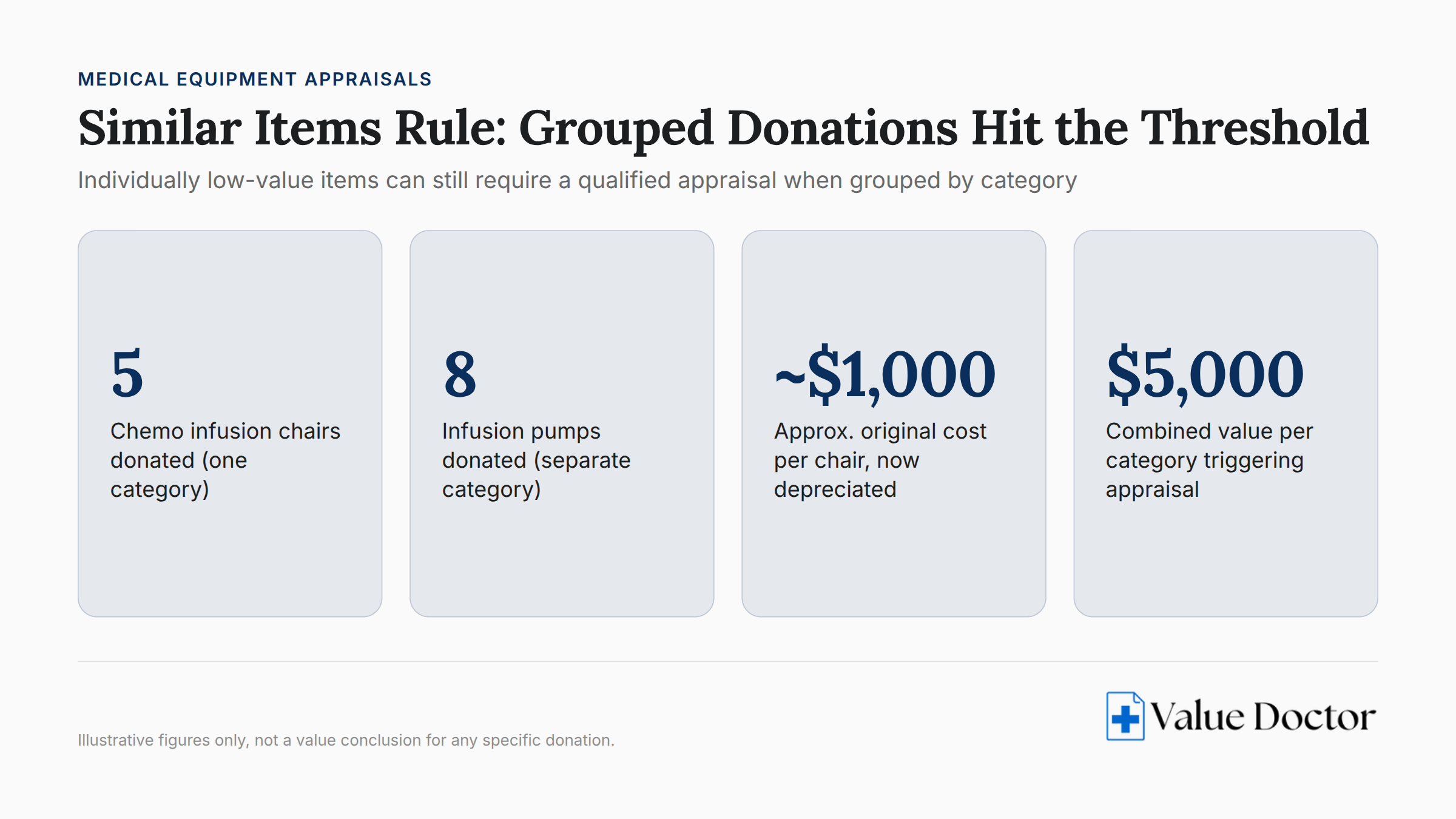
Example: Suppose a clinic donates 5 chemo infusion chairs and 8 infusion pumps to a single charity in the same tax year. Each chair might have cost roughly $1,000 new and, after years of use, carries a modest depreciated fair market value individually. No single chair, considered alone, comes close to $5,000. The same is true for each pump.
But the chairs form one generic category of equipment, and the pumps form another. If the combined fair market value the clinic claims for all 5 chairs, taken together as a similar items group, exceeds $5,000, that group requires a qualified appraisal and a completed Form 8283, Section B. The pumps are assessed separately as their own category; if their combined claimed value also exceeds $5,000, they trigger the same requirement independently. These are illustrative figures only, not a value conclusion for any specific donation, but the structure is exactly how the IRS evaluates real grouped donations.
This is why a clinic's instinct, "nothing here is worth much on its own," is the wrong test. The right test is: what is the combined claimed value of everything in this equipment category?
What Counts as "Similar" (and What Doesn't)
Not every piece of donated equipment gets lumped together. Publication 561's generic category standard means items have to share the same fundamental type before they're aggregated, not merely the same broad purpose of "medical use." An infusion pump and an exam table are different categories of equipment; they wouldn't be aggregated with each other even though both came out of the same clinic on the same day. Several infusion pumps donated together, on the other hand, are the same category and do get combined.
Drawing this line correctly matters because misclassifying items in either direction creates a compliance problem. Treating dissimilar equipment as one group can understate the deduction's real requirements. Treating genuinely similar equipment as separate, unrelated gifts to dodge the threshold is the mistake the rule specifically exists to prevent. When a donation includes a mix of equipment types, each category should be evaluated on its own combined total.
Donating to Multiple Charities Doesn't Reset the Threshold
Splitting similar equipment across several charities does not avoid the aggregation rule. The Form 8283 instructions are explicit that similar items are aggregated across donees: if a clinic gives 3 exam tables to one clinic and 2 more of the same generic type to another charity in the same tax year, the combined claimed value of all 5 tables is what gets tested against $5,000, not each gift in isolation.
What does change with multiple donees is the paperwork, not the threshold. A separate Form 8283, Section B, and a separate appraiser acknowledgment are required for each donee organization once the group as a whole crosses $5,000, even though the underlying qualified appraisal can address the entire group of similar items in one report.
How to Protect Your Deduction Before You Donate
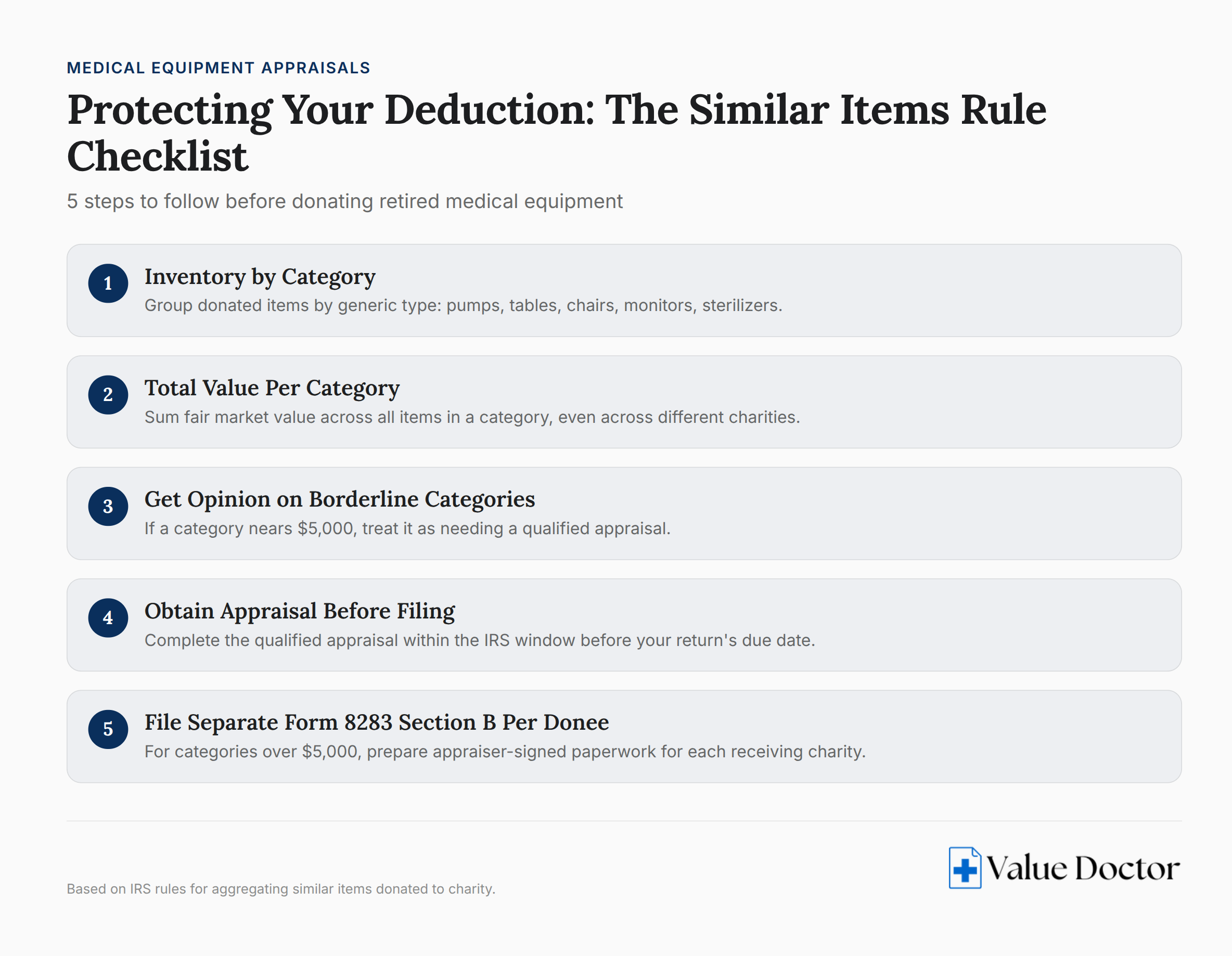
The safest approach for a practice or hospital clearing out retired equipment is to inventory first and value second, by category rather than by item.
- Inventory Retired Equipment by Category
- Group every item slated for donation by generic type (infusion pumps, exam tables, chairs, monitors, sterilizers) before estimating any values.
- Total the Claimed Value Within Each Category
- Add up the expected fair market value across every item in a category, including units going to different charities, to see whether the group crosses $5,000.
- Get a Professional Opinion on Borderline Categories
- If a category's combined value is anywhere near the threshold, treat it as requiring a qualified appraisal rather than assuming it falls under the line.
- Obtain the Appraisal Before Filing
- A qualified appraisal generally must be completed within the window the IRS specifies before the return's due date; waiting until after filing forfeits the deduction for that group.
- Complete a Separate Form 8283, Section B, for Each Donee
- Once the group exceeds $5,000, prepare the appraiser-signed Section B paperwork for every charity that received part of the group.
Our medical equipment appraisal services for charitable donation are built around exactly this kind of category-by-category analysis, so a practice never has to guess whether a group of similar chairs, pumps, or tables has quietly crossed the $5,000 line. For larger equipment liquidations tied to a broader facility upgrade, our hospital equipment appraisal work covers the same aggregation logic across an entire inventory.
Getting the Category Test Right the First Time
The similar items rule catches practices that reason item by item instead of category by category. A stack of infusion pumps, chemo chairs, or exam tables that individually look modest can still add up to a claimed deduction that legally requires a qualified appraisal and a properly completed Form 8283, Section B. Running the aggregation test before the donation, not after the return is filed, is what keeps the deduction defensible.
Our appraisers hold credentials with organizations including the ASA, CAGA, and NEBB, and every report we prepare follows Uniform Standards of Professional Appraisal Practice (USPAP). If your practice or hospital is planning an equipment donation and wants a clear read on whether a group of similar items crosses the appraisal threshold, request a medical equipment appraisal before you finalize the gift.
This article is provided for general informational purposes only and does not constitute legal, tax, or financial advice. Readers should consult a qualified attorney or CPA regarding their specific circumstances.