
Blog
What Drives Used Laboratory Equipment Value: Analyzers, Centrifuges, Microscopes, and Freezers Compared
Used laboratory equipment value depends on support status, records, completeness, decontamination, relocation cost, and the resale channel. This guide shows how each driver moves the number for analyzers, centrifuges, microscopes, and ultra-low freezers.
Published
Key Takeaways on Used Laboratory Equipment Value
Here is what lab managers, practice owners, CPAs, and executors need to know about used laboratory equipment value:
- Supportability: OEM support status, parts availability, and reagent access set the ceiling on resale value for analyzers and other specialized instruments. A working instrument the manufacturer no longer services sells to a much smaller pool of buyers.
- Records: Calibration, qualification, and service records lower a buyer's expected repair and validation costs. Missing records push the price down even when the instrument powers on.
- Completeness: Rotors, objectives, racks, software, and licenses are part of the asset. A centrifuge without its rotors or a microscope without its objectives sells as a partial unit.
- Premise of value: Fair market value, a dealer offer, and liquidation value are 3 different numbers. Fair market value and liquidation value answer different questions, and the report must state which one it concludes.
- Professional valuation: A lab equipment appraisal from Value Doctor identifies each asset, states the premise, and supports the concluded value with market evidence.
Used laboratory equipment value is the price a specific instrument commands given its condition, support status, documentation, and the market that will buy it. Book value and original purchase price explain very little of that number. This guide walks through the drivers for analyzers, centrifuges, microscopes, and ultra-low freezers, compares the main resale channels, and works through an illustrative example.
Used Laboratory Equipment Value Starts With the Premise of Value
The premise of value defines the question an appraisal answers, and it changes the number more than any single condition factor. Fair market value in continued use assumes the equipment stays in place and keeps operating. Orderly liquidation value assumes a reasonable marketing period and a sale to the best available buyer. Forced liquidation value assumes a compressed timeline.
A dealer offer is none of these. A dealer offer is a wholesale purchase price that includes the dealer's costs for removal, refurbishment, warranty, and margin. Fair market value does not fall below what a used equipment dealer would sell the item for, so a dealer's purchase offer usually sits below fair market value.
The intended use decides the premise. An estate inventory, a divorce, and a practice sale call for fair market value. A bankruptcy sale or a closing lab often calls for liquidation value.
How Age and Model Generation Affect Used Laboratory Equipment Value
Model generation matters more than calendar age. A 6-year-old analyzer on a platform the manufacturer still sells and supports can outvalue a 3-year-old instrument on a discontinued platform.
Age reduces value through 2 channels: physical wear and functional obsolescence. IRS Publication 946 describes depreciable property as property that wears out, decays, becomes obsolete, or loses value from natural causes. Obsolescence is the faster channel for instruments that depend on software, detectors, or proprietary consumables.
The appraiser compares the subject against the current generation of the same product line. Throughput, test menu, automation interfaces, and software version separate one generation from the next. A newer generation resets buyer expectations and lowers what the market pays for the older one.
Calibration, Qualification, and Service Records
Calibration and qualification records convert an instrument from an unknown into a documented asset. Buyers discount untested or undocumented equipment because they price in inspection, repair, and revalidation work before the first use.
The records that carry the most weight are:
- Calibration records: Dated results from the most recent calibrations, with the identity of the party that performed them.
- Qualification records: Installation, operational, and performance qualification documents for regulated or clinical work.
- Preventive maintenance logs: Scheduled service visits, replaced parts, and the intervals between them.
- Repair and error history: Service tickets, repeated failures, and any major component replacement such as a compressor, detector, or lamp.
Condition categories follow the records. Equipment that is fully operational and tested sits at the top. Equipment that is operational with known deficiencies, untested, incomplete, or suitable only for parts sits progressively lower.
OEM Support and End-of-Support Status
OEM support status decides how many buyers can use the instrument. When the manufacturer still services a model, ships parts, and issues software updates, the secondary market is deep. When the manufacturer announces end of support, buyers lose service contracts and parts channels, and prices step down.
The appraiser confirms 4 facts about support:
- Whether the model is still manufactured or sold new.
- Whether OEM field service and parts are available for it.
- Whether software licenses transfer to a new owner.
- Whether a manufacturer trade-in or buyback program applies.
An OEM trade-in credit is a purchase discount toward new equipment, not an appraisal. The credit depends on what the buyer purchases and does not measure the market value of the old unit.
Reagents, Consumables, and Closed-System Dependence
Analyzer value depends on whether a buyer can keep running tests. Closed-system analyzers run only on the manufacturer's reagents, controls, and calibrators. If the manufacturer limits sales to the original purchaser or discontinues the assay menu, the instrument loses most of its resale value.
Open-system analyzers accept third-party reagents and hold value better. The test menu, installed base, and reagent availability determine how many labs can use the unit. A hematology or chemistry platform with a large installed base sells faster than a niche platform with few users.
Completeness of Accessories, Decontamination, and Title
Completeness means the accessories that make the instrument functional are present and match. Centrifuges need their rotors and buckets. Microscopes need the full objective set, condensers, camera, and imaging software. Freezers need racks, boxes, and alarm or monitoring equipment. Replacement rotors and objectives are costly, so a buyer deducts their price from any offer on an incomplete unit.
Decontamination status controls whether the unit can ship and install at all. Equipment used with biological, chemical, or radioactive materials needs documented decontamination before a buyer or carrier accepts it. Clear title matters equally: a buyer cannot purchase an asset subject to a lien or an unresolved ownership claim.
Value Drivers by Equipment Type
Each equipment type carries a different mix of dominant drivers. The table below compares the factors that move used value most for analyzers, centrifuges, microscopes, and ultra-low freezers.
| Equipment | Dominant value drivers | Common value detractors |
|---|---|---|
| Analyzers | Platform generation, test menu, throughput, OEM support, reagent availability, software transfer | Closed-system lock-in, end of support, missing service history, discontinued assays |
| Centrifuges | Included rotors and buckets, maximum speed, capacity, refrigeration, safety interlocks, rotor condition | Missing or worn rotors, rotor life limits reached, no service records |
| Microscopes | Optical quality, objective and eyepiece set, illumination, camera and software, fluorescence capability, brand | Scratched or fungus-affected optics, missing objectives, obsolete camera software |
| Ultra-low freezers | Temperature stability, compressor condition, capacity, alarm systems, gasket and door condition, energy use | Compressor failure, frost buildup, refrigerant issues, relocation cost, no decontamination record |
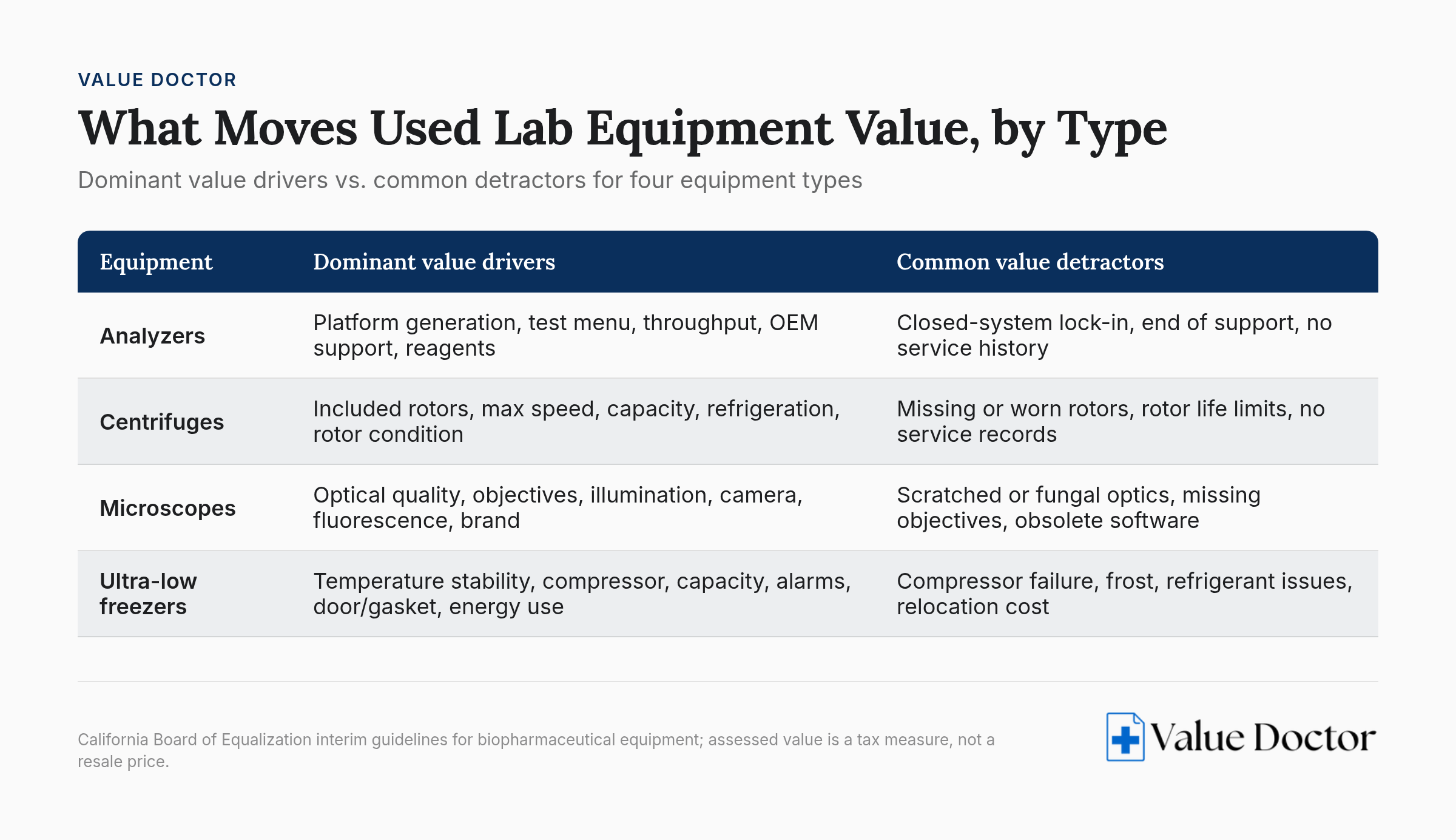
The California Board of Equalization's interim guidelines for biopharmaceutical equipment list centrifuges and rotors, microscopes, and refrigerators and freezers as distinct equipment categories. The guidelines apply valuation factors to historical cost by acquisition year to reach assessable value for property tax. Assessed value is a tax measure and does not substitute for a resale price.
Logistics and Relocation Risk
Relocation cost is deducted from what a buyer will pay. Removal, rigging, packing, freight, installation, calibration, and revalidation all come out of the buyer's economics before the buyer sets an offer.
Ultra-low freezers carry the highest relocation risk. A freezer holds temperature-sensitive contents, so the move needs controlled transport and a plan for transferring samples. The compressor can fail after a move and a long power-down, which makes buyers cautious about units without documented performance logs. Floor centrifuges and large analyzers add rigging and site-preparation costs.
Example: Consider an ultra-low freezer in a closing practice, with illustrative numbers only. Fair market value in continued use, assuming a documented unit with clean temperature logs, is concluded at $2,400. A specialist dealer offers $900 because the offer covers pickup, testing, and resale margin. A forced sale to a surplus buyer returns $700 after the buyer subtracts rigging and uncertainty about the compressor.
The $2,400 figure answers a fair market value question for a buyer who inspects the unit in place. The $900 figure is a wholesale purchase price. The $700 figure is a liquidation outcome under time pressure. An executor or CPA who records the $900 offer as fair market value understates the asset by $1,500.
Resale Channels for Used Laboratory Equipment
The channel that sells the asset shapes the price the seller receives. The same instrument produces different net proceeds across channels because each one passes different costs and risks to the seller. The table below compares the main channels.
| Channel | Typical buyer | Seller advantage | Seller trade-off |
|---|---|---|---|
| Direct end-user sale | A lab or practice that will use the unit | Highest price, no intermediary margin | Slow, requires marketing, inspection access, and shipping coordination |
| Specialist dealer purchase | A dealer who refurbishes and resells | Fast payment, dealer handles removal | Wholesale price, dealer margin deducted |
| Consignment | A dealer who markets the unit for a share of the sale | Higher price than outright purchase | Unpredictable timeline, commission, and storage or condition risk |
| OEM trade-in | The manufacturer, as credit toward new equipment | Convenient, tied to a new purchase | Credit reflects the new sale, not the market value of the old unit |
| Auction or surplus marketplace | Mixed buyers, often bargain-seeking | Fast, broad exposure | Liquidation-level pricing, buyer's premium, no warranty |
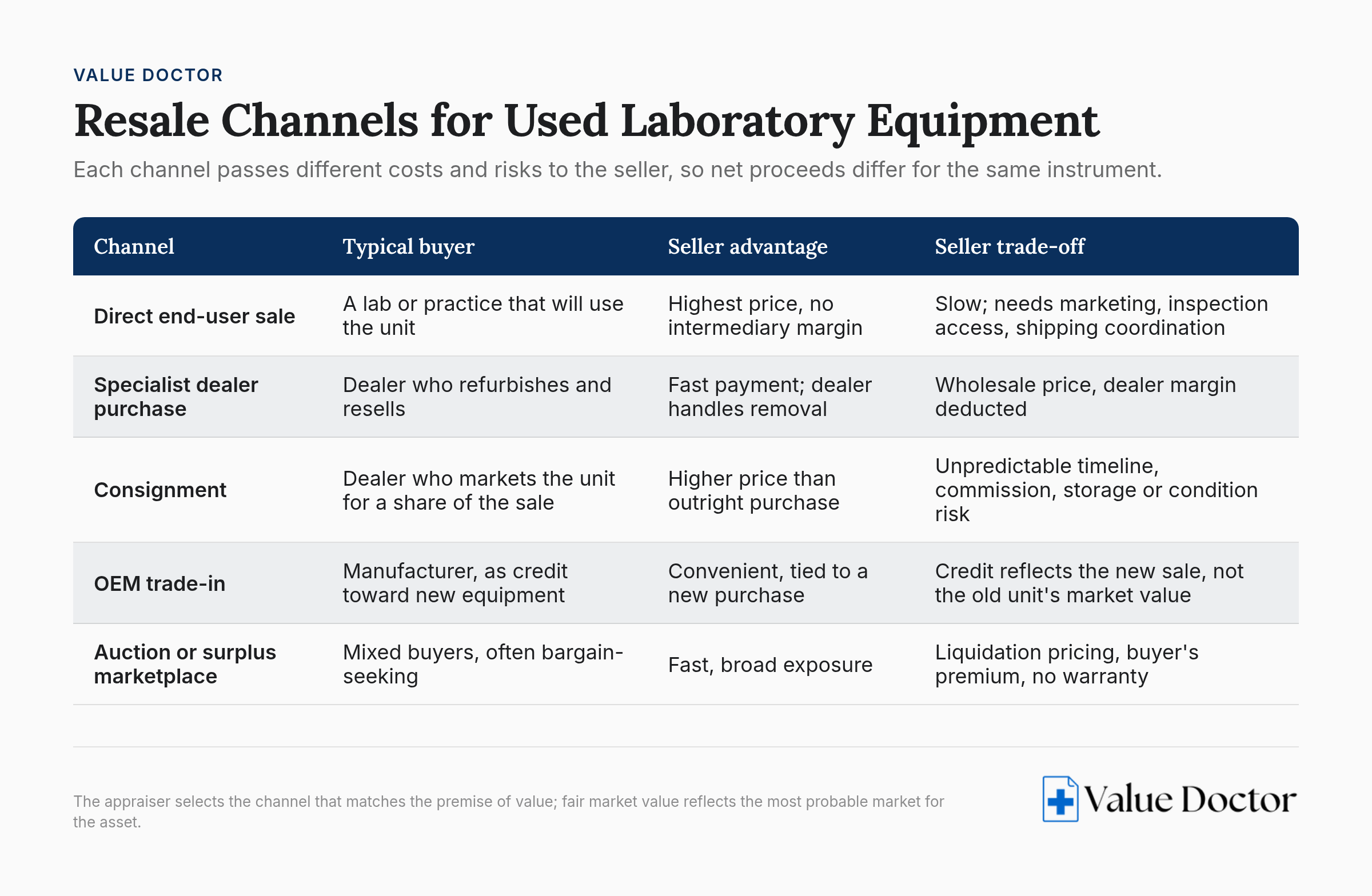
The appraiser selects the channel that matches the premise of value. Fair market value reflects the price in the most probable market for that asset, and for complex analyzers that market is usually a specialist dealer or end user. For common items such as freezers and basic centrifuges, a wider auction and dealer market exists.
Book Value, Depreciation, and Used Laboratory Equipment Value
Book value and market value measure different things. Depreciation schedules reflect cost recovery for tax and accounting purposes, not what a buyer will pay.
The IRS internal property and equipment policy in the Internal Revenue Manual sets a $50,000 capitalization threshold and a 5-year useful life for laboratory and forensics equipment. That figure documents IRS accounting policy and does not function as a resale depreciation rule. A 5-year-old analyzer fully depreciated on the books can still carry substantial market value if the platform remains supported.
Original cost is a useful starting point for identifying the asset and its acquisition year. Market value then requires current condition, support status, comparable sales evidence, and the cost to place the equipment in service.
Getting a Defensible Number for Used Laboratory Equipment
A defensible value requires an identified asset, a stated premise, verified condition and documentation, and market evidence suited to the equipment category. Value Doctor appraisers research each instrument, note the support status and completeness, and prepare the report in accordance with USPAP. Our appraisers hold credentials with leading organizations such as the ASA, ISA, and CAGA, and the report is built for its intended use, whether that is an estate, a practice sale, or a financial filing.
Value Doctor quotes a fixed fee before work begins and never bills hourly. Published pricing for lab equipment appraisal starts at $295 for a standard report and $395 for an advanced, IRS-qualified report, with typical engagements running $695 to $2,200. Scope sets the fee: the number of assets, the complexity of the instruments, the quality of the records, and the intended use. The concluded value of the equipment does not change the fee.
Gather the serial numbers, service logs, calibration records, accessory lists, and decontamination documentation before the appraisal begins. Complete records shorten the research and strengthen the supported value.
This article is provided for general informational purposes only and does not constitute legal, tax, or financial advice. Readers should consult a qualified attorney or CPA regarding their specific circumstances.